
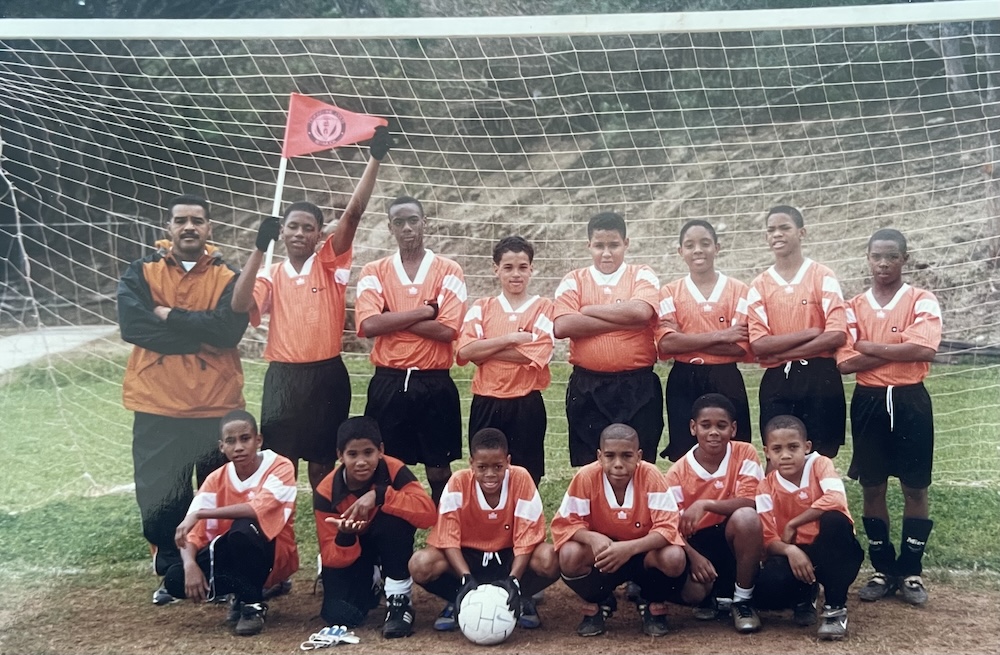
Devonshire Colts Football Club was established in 1958, born out of the Howard Academy school football team, also known as Skinners School.
At the centre of that origin story are two men whose vision reached beyond the touchline. Edward DeJean, the school’s principal, and Braxton Burgess, a physical education teacher, believed sport could sharpen the mind as much as it strengthened the body.
Their all-boys team became one of the best in Bermuda, before progressing to practice matches against local men’s football teams, and then entering the Bermuda Football Union. A school team had been transformed into the beginnings of a football club with staying power.
This was not just about sport. It was community building in a society where exclusion and inequity were normalised, and where Black Bermudians had to create structures of support so their people could advance.
Much of what defined that era has shifted, but the need for Black led networks of mentorship, opportunity, and mutual aid has not disappeared. It remains part of how families, clubs and community organisations help young people navigate barriers and build futures.
Like many community stories in Bermuda, the club’s early years were shaped by movement and sacrifice. After the high school team years, many players went abroad to continue their studies. The team itself paused. But the connection did not break. Four years later, after completing their education, many of the original players came back together, bringing with them a renewed commitment to each other and to the idea that had first taken hold at Howard Academy.
Mutual support
They formed a group called The Mutual Associates. Members paid dues into the organisation with the objective of purchasing shares in Black businesses. That detail matters because it speaks to how Black organisations and Black enterprise have long supported each other in Bermuda. From that pool of contributions, they decided to use some of the money to restart Devonshire Colts and enter the second division of the Bermuda Football Union. They were rebuilding a club and strengthening a community at the same time.
From the beginning, Colts have never been limited to one sport. The same founding philosophy of combining sport with learning has carried through, and the club has seen success in both netball and bowling. Football has remained the heartbeat, but the broader message has always been present. Sport can open doors, but it also teaches you what to do once you’re inside.
That sense of purpose is exactly how the current president, Zuri Darrell, describes Devonshire Colts today.
“Devonshire Colts has been a staple in the Devonshire and Bermuda community by providing a safe place for young black men to grow in sport,” he said, “but also fostering educational opportunities and mentorship for all those parts of the DC family.”
Family affair
For Mr Darrell, the club’s longevity is not accidental. He points to a culture that has endured across decades, even as the sport and society around it have changed.
“The family atmosphere at DC has been key to its longevity and success,” he said.
That family identity is not just a feeling. It is how people relate to the club across generations. “It is everything at DC,” Mr Darrell said. “The family legacies and multi-generational participation cannot be emphasised enough. If you’re a Colt, you’re family. Family sticks together and is the bedrock of our existence.”
He hears it all the time from players and families.
“Many players say, ‘my daddy, or my uncle played for the Colts, this is my club’ or ‘the Colts is my family, family always supports each other’.”
The Colts have also evolved with changing times.
“We provide a sustainable youth programme that mentors young men and women, and we educate coaches and former players on the laws of the game to be able to give back. The DC family has always supported its members in their educational and vocational pursuits through scholarships.”
He also points to growth in girls’ programmes, including DC Diamonds netball and girls’ football at Under 7 and Under 9.
Mr Darrell notes that the Colts also support young people beyond sport, including helping in special situations, such as when youth members head off to college.
“We instil discipline by engaging in community projects and showing our young members that you must be well-rounded to succeed in life beyond football,” he said.
As I write this article and learn more about the history of Devonshire Colts, it is more than just another freelance project.
It brings back the legacy of my late uncle, Vic Ball (1949-2023), and the stories I grew up hearing about his time playing football.
Mr Darrell remembers Mr Ball as a leader who served the club as a player, coach, president and friend.
He shared one story. During a period of internal conflict, when a small group attempted to pull the club away from its founding principles and values, Mr Ball stepped in and steadied the club.
For me, it is a reminder of my Uncle Vic, as he always was: someone who looked out for people and had integrity in everything he did for his family, his work, and his community.
For my family, that continuity is not a metaphor. It runs from Uncle Vic to my youngest son. My youngest son, Rainn Ball-Burgess, plays for Devonshire Colts Under 11s, coached by Mr Darrell. In that small detail, you get a glimpse of the club’s larger story: the names and faces have changed throughout the decades, but the club’s purpose has held.
The club was evicted from its Frog Lane Field base when the North Field of the National Sports Centre was built, but its programmes continue through rented facilities and community partners.
As young players show up for a game on a Saturday morning, if you are keen, you may still see it: the past and the present meeting on one field.
Devonshire Colts Football Club remains a steady place where young people are seen, guided, and held to something bigger than themselves, a club that has spent decades teaching Bermuda’s young people how to show up on and off the field and take ownership not just in a club, but as active community participants.
