
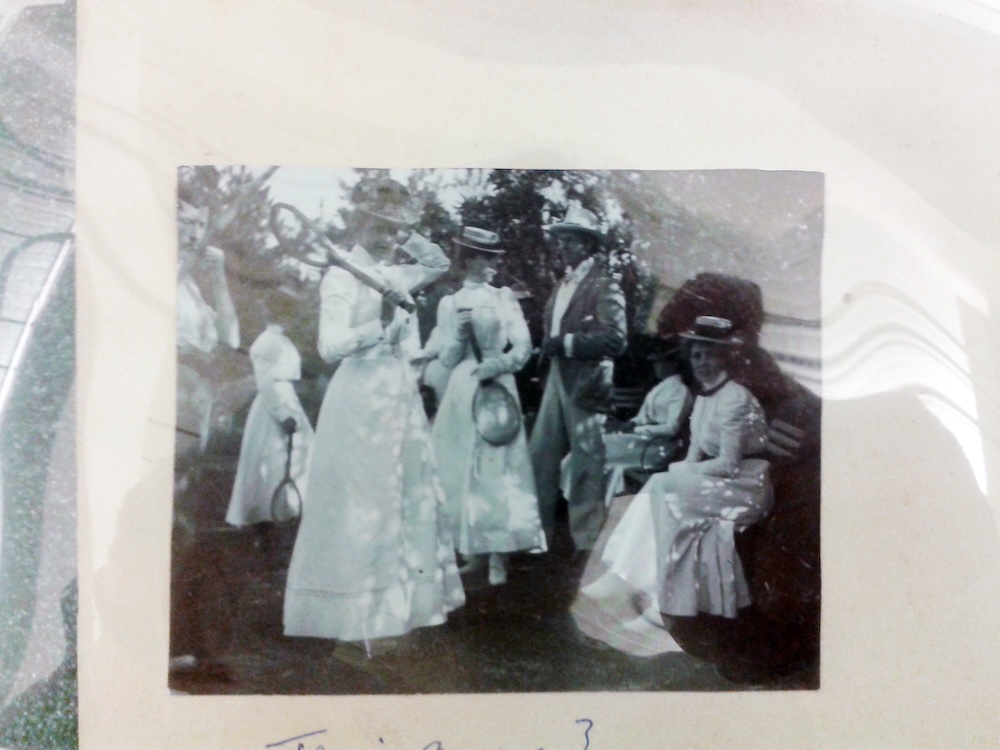
In April 1876, a little-known grass court tennis tournament took place at Admiralty House, Spanish Point. Likely a first of its kind in the Western Hemisphere, it cemented Bermuda’s place in the annals of tennis history and was a ladies singles tournament won by the then 15-year-old, Mary G. Gray.
“My younger brother pleaded that I should be allowed to play in the Ladies’ Singles, in fact, as well as I remember, that was the sole event,” she wrote in an article entitled ‘A Bermuda Tournament in 1876’, published in American Lawn Tennis, September 15, 1924.
“There were, I think, only four entries. I first met my sister and won two games to one. I then played the final against Miss Key, daughter of our Admiral, Sir Cooper Key, and won 2-0.”
The prize was a “tilthead” racquet with a red velvet handle covering and a silver plaque, which read “Ladies Prize for Lawn Tennis Won By Miss M G Gray Bermuda 1876.”
In spite of the tournament’s impact, it appears there was no news coverage of it at the time. Yet, its legacy lives on to this day, not just in Bermuda, but in the popularity of tennis worldwide.
Recognising the trophy’s significance, the International Tennis Hall of Fame in Newport, Rhode Island, bought the racquet when it was auctioned by Christie’s, London, in 2001, for £14,100 ($19,085).
“It is currently on display in our early international tennis history gallery and is a show-stopper artifact in our collection,” said Nicole Markham, the Hall of Fame’s curator of collections.
“It is a fascinating item, as it relates to an event that predates the first Wimbledon Championships.”
The first Wimbledon Championships were held at the All England Croquet and Lawn Tennis Club in 1877.
Miss Gray “promptly tore off” the red velvet which, said Christie’s, “suggests that she may well have used it in further matches.”
Much has been written about the fact that Bermuda introduced the modern game of tennis to the United States via Mary Ewing Outerbridge. The story goes that she took a set back to the Staten Island Cricket and Baseball Club in early 1874, after seeing it played by British soldiers stationed in Bermuda. However, the exact circumstances and this date have been questioned and some suggest that Mary Gray should be given more acclaim.
‘Undignified game’
Mary G Gray was born in 1860 and grew up at Clermont in Paget. Her father, Sir Samuel Brownlow Gray, was Attorney-General of Bermuda and later Chief Justice. He rented the house from the Butterfield family and, according to the Bermuda National Trust’s, Paget book, was responsible for creating the island’s first tennis court there for “his enthusiastic family”, which “gets credit for being the direct ancestor of tennis courts in the United States”.
In addition to Miss Gray, her brother, Sir Reginald Gray, was also a keen player and, she wrote, he “was one of four gentlemen who played the first game of lawn tennis that took place at Wimbledon which seems to have been during the year 1874.”
Miss Gray acquired her first tennis set in 1875 from a Mr Tom Middleton.
“An elderly gentleman in Bermuda saw the game advertised and sent to England for a set of net, poles, racquets, etc. On its arrival he was so horrified at the idea of ladies playing such an undignified game that in order to prevent his equally elderly wife from attempting to take it up, he decided to dispose of the whole concern – thus it came into our possession and the ball was started rolling in Bermuda,” she wrote.
According to tennis historian, the late Frank Van Rensselaer Phelps, writing in the Summer 2003 issue of The Tennis Collector, it is Miss Gray’s recollection of this date and the fact that British Major Walter Clopton Wingfield’s pamphlet, “The Major’s Game of Lawn Tennis,” wasn’t published until February 25, 1874, that calls into question the date Mary Ewing Outerbridge actually brought her tennis equipment back to the US. He thinks it is far more likely that she took it back after visiting Bermuda on a later trip, in April 1877.
Great excitement
A letter published in The Royal Gazette and Colonist Daily on Tuesday, June 9, 1931, also confirmed Miss Gray’s influence in the Mary Outerbridge story, quoting a letter from Philip B. Smith, who not only called Miss Gray “the dean of Bermuda tennis,” but also quoted her saying: “It was with us that Miss Mary Outerbridge first played.”
Once she got her hands on her first tennis set, Miss Gray didn’t look back and continued playing into her eighties.
Her first tennis partner was Miss Wood, daughter of the Chief Justice Mr TL Wood and, wrote Miss Gray, “in the course of five or six weeks we played each other 101 singles, of which she won 49 and I 52.” The “bats were made of wood and of course the balls were uncovered.”
After the April 1876 tournament, another ladies tournament was held in 1880, and then in 1889, American tennis players, Ellen and Grace Roosevelt visited Bermuda.
First cousins to Franklin D. Roosevelt, “Ellie” as Miss Gray called her, “had either won the American Championship the previous year or else became Lady Champion that year, possibly both.”
There was, she said, “great excitement” at their arrival and matches between the sisters, Miss Gray and a Mrs Erskine were played.
Bermuda quickly became a popular destination for American players and, explained Miss Gray, “The first open tournament held after that of 1876 was the first annual one of the Hamilton Hotel Tennis Club in 1913 (an interval of 37 years) in which quite a number of Americans took part.”
The legacy of the 1876 tournament and its victor, Mary G Gray, was an inspiration to the many players who came after her, however, she reflected: “I feel morally certain that no one in the world has ever derived more genuine pleasure from their tennis career than I have.”
