
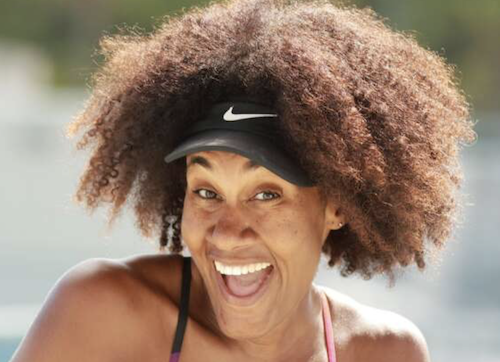
For as long as Katura Horton-Perinchief can remember, she was exhilarated by leaping from great heights.
It didn’t matter whether it was from the top of Somerset Bridge, a boat, or simply into a puddle. She was always destined to jump, and, as it turned out, she was at her best when doing it head first.
By the age of 21, she was competing at the pinnacle of her sport, representing Bermuda in the women’s 3m springboard at the 2004 Olympic Games in Athens.
Not only was she the island’s first diver to represent Bermuda at this level, but she was also the first Black woman to do so.
“It was a very lonely road, coming up, at that time,” she said. “As I branched out and went around the world, and dove, I was often the only Black child.”
That has now changed, and a driving force behind that change was Ms Horton-Perinchief.
A particular memory that has stuck with her since she was 18, was meeting a young Canadian girl of Haitian descent at a competition.
“Her dad was like, ‘100 percent, this is amazing, I’m so glad to see you,” she recalled. “I think that does something to you. If you see someone who’s doing it and they look like you.”
This young girl was Jennifer Abel who went on to become an Olympic diving medallist.
People often ask Ms Horton-Perinchief, now 43, how it feels to be the first.
“I wish I hadn’t been,” she said.
“Why should you have to be breaking colour barriers ever? I love that today’s kids don’t have to break that barrier. That the sport has become so much more inclusive and overall, we’re seeing a lot more success from athletes of all backgrounds. That warms my heart.”
Overcoming challenges
Wherever you come from, an elite athlete’s path to the top of their sport is littered with challenges, and Ms Horton-Perinchief is grateful for her “wildly supportive family” and “incredibly supportive island”.
Her family is from Somerset, but she grew up in Toronto. Her initial Olympic dream had been to compete as a gymnast, but when it became apparent she was going to be too tall for that sport, diving was the natural alternative.
“It’s a very similar sport, other than we maybe land on our heads and gymnasts land on their feet,” she laughed.
Her journey to the top involved training six days a week from the age of 12, every day after school and then all day on Saturdays. As she advanced, her family had to move closer to the pool so she could train before school as well.
After competing in Athens, Ms Horton-Perinchief wanted to qualify for one more Olympic games before retiring, but that was not meant to be.
“I was injured while training for the Beijing Olympics,” she said, and that meant she could not compete.
“It was always my plan to go to those two Olympics and then retire on my own terms, and unfortunately I didn’t get to make that choice.”
From her own personal disappointment, however, came new legacies.
In spite of her rigorous training schedule, she never took her eye off her academic studies and in 2013 she earned her Masters’ of Public Health from The George Washington University. After her injury, she moved back home to Bermuda and was appointed manager of the newly established Bermuda National Tumour Registry.
“We had never had a cancer registry, or any chronic disease registry since, and again, it was a ground-breaking endeavour in that it can help shape policy and process, but what I loved about it was it allowed me to use my public health background,” she said, adding: “I’m not averse to starting new things. To build something new from the ground up.”
She is currently completing a doctorate in public health through the University of South Florida, which, she explained, “will be the culmination of my academic career.”
Supporting the next generation
She has, however, remained devoted to sport, in particular diving, and she has been on the World Aquatics judging list since she retired.
To give back to both the sport, and to Bermuda, she completed her Masters’ of Business Administration (MBA) in 2013, and two years later established Star Diving, an award winning summer camp, which is still going strong 12 years later.
“Watching kids be introduced to a sport that grew me from the ground up is one of the greatest joys of my life,” Ms Horton-Perinchief said.
“To watch them take their power and say, ‘Wow, I can do something I didn’t think I could.’ Convincing kids that their limit is a lot closer to space than they ever would have imagined, it gives me goose bumps.”
Every year, just for the children, she dives off the 10m platform and while she admitted to being “a little bit more scared now,” she said “it’s still just as exhilarating to get up there.”
She also gives back to sport through her work for the Bermuda Olympic Association, of which she is an executive board member and is proud to have been Bermuda’s Chef de Mission for the 2024 Paris Olympics, and 2018 Commonwealth Games.
Could Bermuda produce another Olympic diver?
“Absolutely,” she said, but only if there is “political will to make sure that we have a facility that can allow for our kids to train year round.”
This doesn’t have to be an indoor aquatic facility, it could be what she calls a “dry land facility”.
For any young girls with big dreams of making it to the top of their sport, she said: “You belong at the top of every single ladder, and so, as long as you are willing to do whatever it takes to climb that ladder, make sure that you keep going.
“Your gender, your race, your ability or disability should not be holding you back from achieving whatever it is that you need to achieve.
“If the ladder doesn’t exist, go ahead and build that ladder.”
