
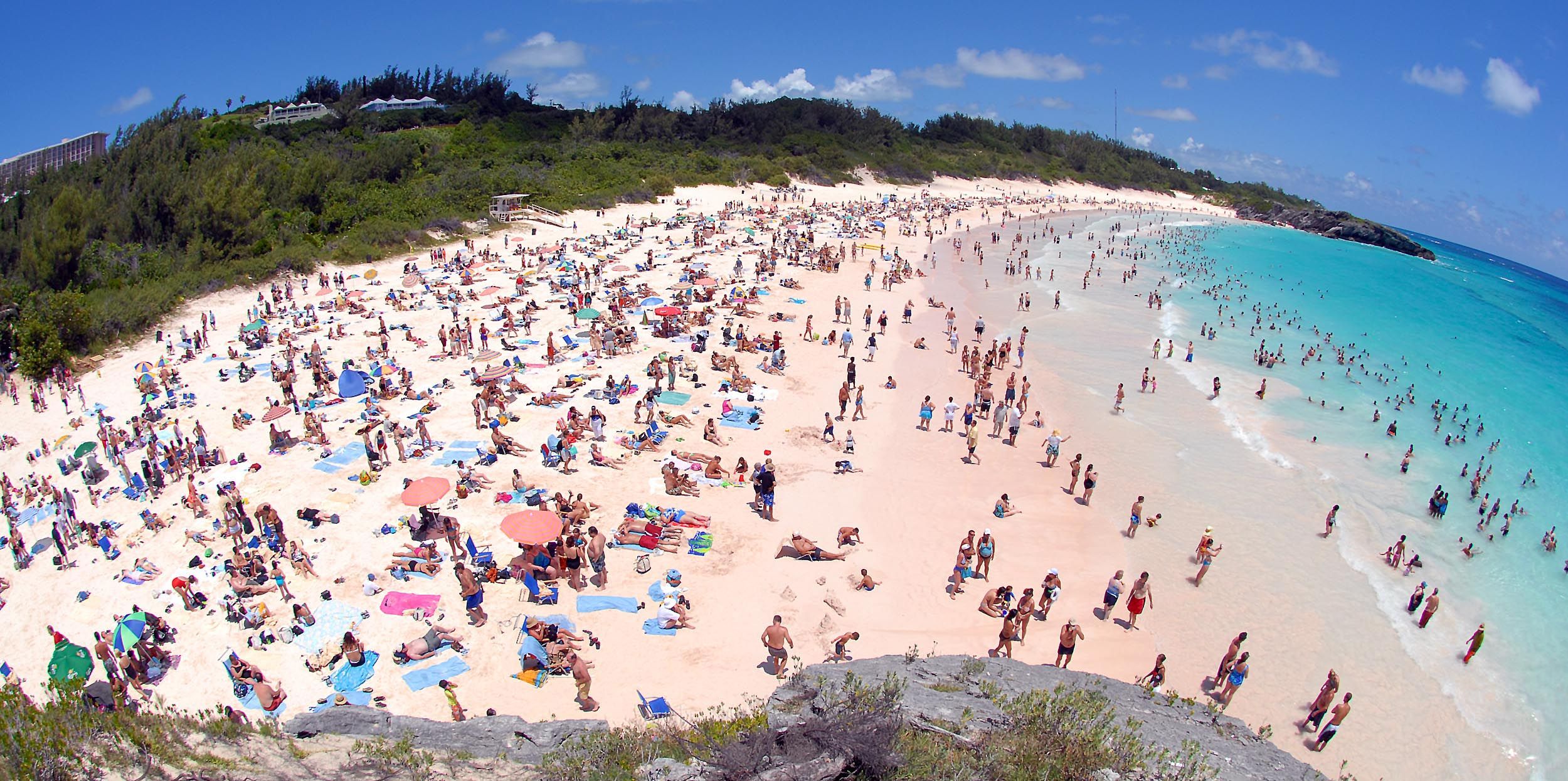
In Bermuda, we describe our sand as pink, although the colour isn’t always immediately obvious.
From a distance, many of the island’s beaches appear closer to white. The pink becomes more noticeable under certain conditions, particularly where the sand is damp or the light is softer. Even then, it is not uniform across the beach.
For visitors, it is often something that needs to be pointed out; for residents, it is easy to overlook.
Still, the colour is something we brag about. Many of us do it without knowing how it came to be.
The pink is the result of the breakdown of foraminifera, microscopic forms of marine life with red or pink shells that live on the underside of coral reefs. When they die, the shells are broken down by wave action and carried ashore, where they mix with Bermuda’s naturally white sand, which is formed largely from crushed coral and calcium carbonate.
Over time, that material accumulates. The result is not a solid colour, but a variation in tone. Some areas appear pinker than others, depending on how much of the red shell material is present and how it has been distributed along the shoreline.
The effect can change from day to day. Stronger surf can bring more of the pink fragments to the surface, making the colour easier to see, while calmer conditions may leave the sand looking lighter. Heavy wave action and foot traffic can also make the colour less noticeable.
The pinkest sand is generally found along Bermuda’s south shore, where offshore reefs supply the material that forms the beaches. Horseshoe Bay is the most widely recognised example, but the same effect can be seen at Warwick Long Bay, Jobson’s Cove and Elbow Beach, all of which face the open ocean, allowing a steady movement of sand and shell material.
Even within those areas, the colour is not consistent. Some stretches show more of a pink tint than others, and the difference is often more noticeable closer to the water’s edge, where the sand is wet and more compact.
Perspective also plays a role. The colour tends to appear more clearly when viewed up close, particularly in the grains themselves rather than across a wide expanse of sand. Looking at the sand in your hand often reveals the contrast more clearly than looking across the beach.
In many cases, the pink appears as a faint tint rather than a strong colour. Photographs often suggest a brighter shade than what is seen in person. Lighting, editing and the angle of the image can all exaggerate the effect, creating an impression that does not always match what is found on the ground.
The colour that is there is the result of natural processes, shaped over time by the interaction between marine life, coral reefs and the movement of the ocean.
