
When the inevitable happens in Bermuda and ants or cockroaches invade your home, it would be desirous if a bit of gentle persuasion might prompt them to return to their homes in nature (or even next door).
However, thinking that you can send them on their way with a gentle “shoo, you guys, shoo” has been the undoing of many a peaceful homeowner.
Steps must be taken to rid your home of unwelcome guests – but what method should you use?
It’s tempting to reach for Baygon, or a similar insecticide, due to its proven effectiveness as a bug killer.
However, you need to be careful; health regulators worldwide have studied the impact of propoxur, the active agent in Baygon, since it was first introduced in 1959 by the German company, Bayer AG, producing reports that are written in highly technical language.
Institutions of higher learning have weighed in as well, often with a plainer language approach.
The University of Hertfordshire, in its Pesticide Properties Database, concludes, in part: “It is highly toxic to humans if it is ingested but no other serious health issues have been identified.
“There are gaps in information relating to the toxicity of propoxur to biodiversity but based on information that is available it is likely to be moderately to highly toxic.”
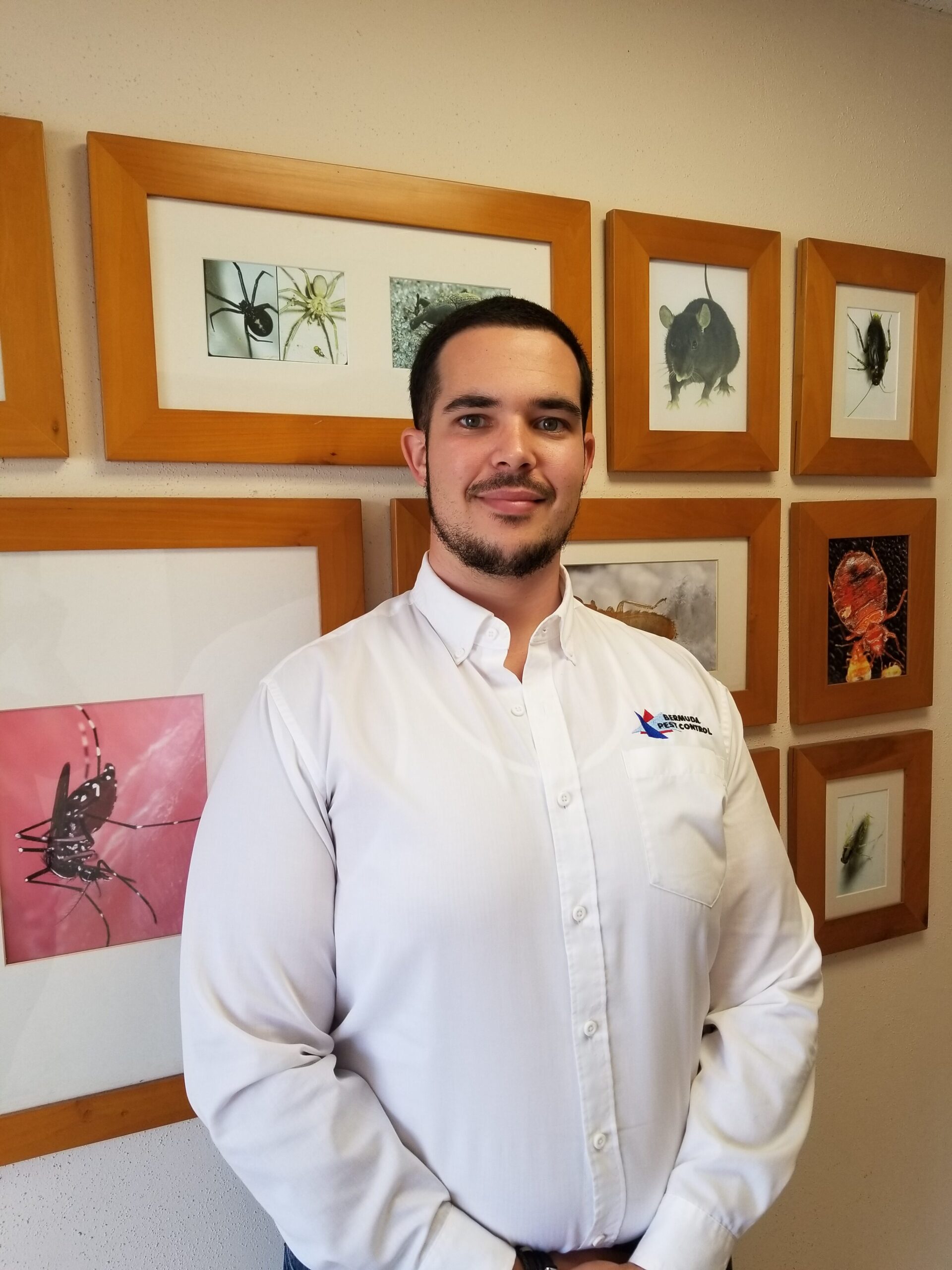
Justin Tavares is the operations manager at Bermuda Pest Control, which has been in business since 1952.
He said how homeowners deal with bug issues is based on their “pest threshold”.
“For some people, they see an ant, they go running. For some people, they see a cockroach, it’s like, ‘Oh, not a big deal, I don’t care’. So, with that comes the idea of, OK, is reaching for Baygon the best solution in all situations? Probably not.
“You don’t need to necessarily grab Baygon and spray down an ant trail. You could spray Febreze or Windex or anything along those lines and it would kill the ants.
“But it comes down to people’s comfort level. So, a lot of times Baygon and similar products like Raid are what people are used to, they go for what they know works, and they go for a lot of times the quickest solution.”
Keep things clean
Bermuda Pest Control practises “integrated pest management”.
Mr Tavares said: “It’s the idea that chemicals are more of a last resort and more of the customer’s threshold if they want that sort of thing.
“Whenever any of our technicians go out in the field, the first step is prevention. It’s making sure that any cracks or crevices are filled.
“Sometimes people like to leave their windows open or their doors open, especially if there’s a nice breeze going through. Great, but that also invites pests into the home.
“So, taking care of the property is the number one thing. Keeping things clean, keeping things in good order, making sure screens are fixed.”
Mr Tavares said the bottom line when considering whether to use a product is as simple as reading the label.
That has become more straightforward since the launch of the Globally Harmonised System of classification and labelling of chemicals, a framework recognised worldwide.
Mr Tavares said: “There were different parts of the world where ‘caution’ and ‘danger’ were used interchangeably. I think it was back in 2016, where they kind of got everybody on the same page of what does this mean, what’s the levels here, what are the images that we’re using for these, and everybody sort of got on the same page for that.”
He added: “For any pesticide, the label is the law. If the label says ‘one quick spray for one second, leave the room for four hours’, well, then you need to do one quick spray and leave the room for four hours. If it says wear protective equipment, wear protective equipment.”
Handle with care
Any product used in Bermuda must pass the muster of the island’s regulators.
Mr Tavares said: “We’re not sneaking anything under their watch. They are very vigilant about that.”
He said Bermuda Pest Control offers a range of solutions, including “green products”.
However, he added of chemicals: “As long as they are used correctly and the label is followed, any chemical can be used safely. They’re not necessarily going to be bad for the environment.
“That’s where a lot of the expertise comes in … taking the steps before it gets to chemical control. And then when it does get to that point where the homeowner or the businesses are at a point where they can’t handle it themselves, that’s when we step in.”
He added: “I’ve heard the term ‘spray jockey’ thrown out before, and that’s certainly not the case with Bermuda Pest Control. We make sure that if chemicals are needed, it’s the appropriate chemical in the appropriate location at the appropriate time with the appropriate precautions.”
He said bug problems can be addressed by homeowners directly.
“Essential oils can help. Peppermint oil, in particular, is effective against rodents, against certain insects.
“Citronella oil is another popular one. There’s a reason that everybody has those tiki torches that are citronella scented to help keep away mosquitoes.
“I’ve had people ask me all the time, ‘I’ve got slugs and snails in my garden — what do I do?’
“A lovely green solution is eggshells. You crumple up eggshells and scatter them in the garden. It’s not only a good way of composting, but also the shells kind of cut the snails and the slugs and they don’t like that, so they avoid it.”
Mr Tavares said any pest control measures must also consider the biodiversity of the property.
“If a chemical or anything is used improperly, it could harm a non-target pest. If you’re using salt to take care of slugs and snails, yes, that’ll work on them.
“But how does that affect tree frogs? How does that affect lizards? How does that affect the plants that you’re trying to protect from these slugs and snails?”
