
Bermuda’s early buildings were shaped by a constant balancing act between what was available, what was needed and what the island itself would allow.
Survival was top of mind for the settlers. When they arrived in the 1600s, the easiest materials to access were Bermuda cedar and palmetto. As such, they built houses almost entirely from wood.
Although there is an element of uncertainty, it’s a history laid out by the Bermuda National Trust. According to its website, timber frames were set into the ground, with gaps “likely” filled using cedar lathes and coated in a limestone-based plaster. Roofs were thatched with palmetto leaves — quick to assemble, but far from durable.
According to the Trust: “No buildings finished in this manner survive so it is impossible to be certain how they were built.”
By 1687 structures were better documented. Governor Sir Richard Robinson recorded 579 houses on the island: 29 had stone roofs, 63 had wooden shingles, and the rest were thatched.
At that stage, stone construction was still rare. As shown in a detailed 1624 map by John Smith now on display at Verdmont, a Trust property in Smith’s, the only buildings known to have been built that way were forts, and the State House in St George’s.
Things began to change towards the end of the 17th century as Bermuda’s economy evolved. Shipbuilders were using increasing amounts of cedar, leaving less available for house building.
Limestone proved itself to be a more durable alternative and in 1693, land granted in St George’s came with a condition: build in stone.
Even with that, change was gradual until nature intervened.
Two powerful hurricanes in 1712 and 1715 tore across the island, causing widespread damage. In the aftermath, practicality began to outweigh tradition.
As stated by the Bermuda National Trust: “In some cases the wooden walls of standing buildings were replaced by stone rather than by total rebuilding.”
It was a practical solution — and one that helped define what would become Bermuda’s vernacular architecture.
Evolving styles
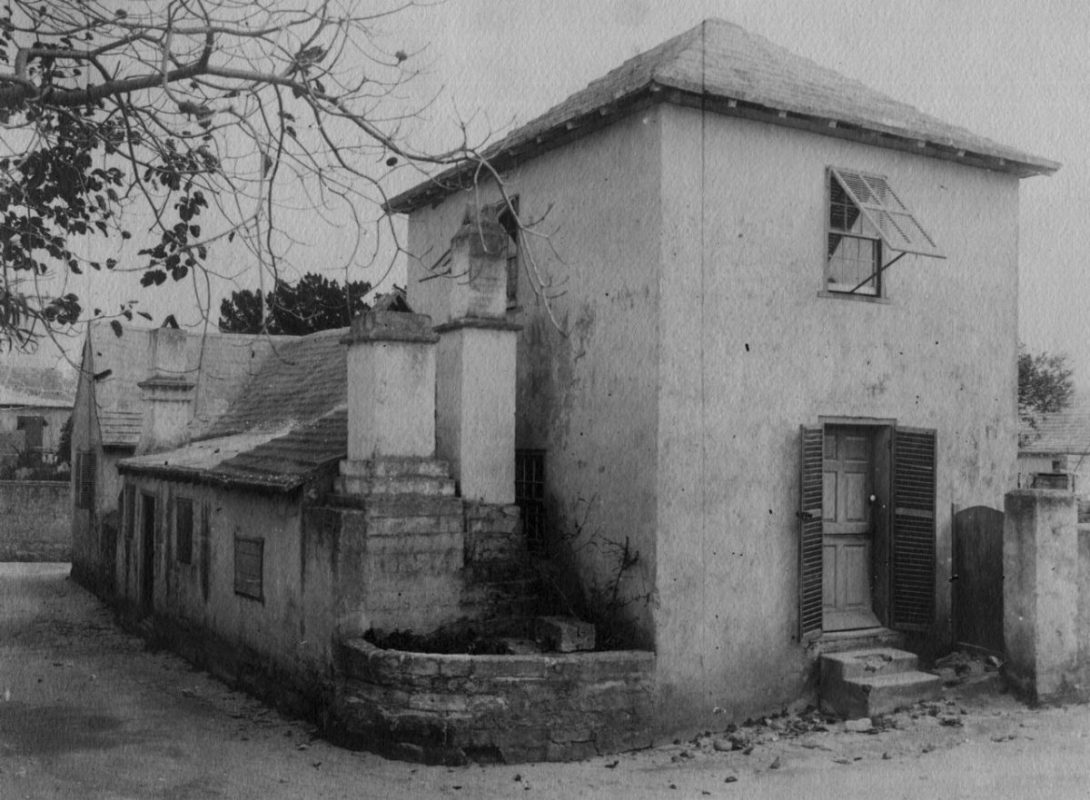
Houses were built to last, but also to work with the landscape. Gable roofs, supported by substantial chimneys at either end, became common. Windows were tucked just under the eaves, helping to keep interiors cool while allowing air to circulate.
Many homes were just one room wide, with additional sections added over time, often at right angles. Steps leading up to the entrance were sometimes straight but often flared outward — a feature now known as “welcoming arms”.
With weather in mind, placement mattered and homes were frequently built into hillsides or along sheltered shorelines, keeping them out of the wind and away from valuable farmland.
Living spaces were raised above cellar areas. There were also outbuildings, used as kitchens, butteries or, in some cases, as accommodation for slaves.
Examples can be seen today in places like the Old Rectory and Fanny Fox’s Cottage in St George’s, and Carter House in St David’s.
Influenced by the Georgian style popular in Britain, buildings in Bermuda became more symmetrical, more formal and, in many cases, more expressive of status during the 18th century.
As described by the Trust, gable roofs gradually gave way to hipped roofs. Facades were balanced, with centrally placed doors and evenly spaced windows. Decorative elements such as pilasters and quoins appeared, framing corners and entrances.
Aesthetic appeal
The evolution from function to form continued into the 19th century. Roofs became shallower in pitch, verandahs were introduced, and details grew more elaborate. Semi-circular windows appeared above doorways, while decorative detailing around doors and windows became more common.
Windows shifted from the traditional six-over-six panes to simpler two-over-two designs, allowing for larger panes of glass and clearer views out. Bay windows were introduced, projecting outward from the wall they brought in more light and created a greater sense of space inside. Chimneys, once purely practical, became increasingly decorative — with some built in octagonal forms and, by the late 19th century, others added simply for show.
Although Bermuda never lost its architectural roots, appearance began to matter more.
Some roofs were covered with slate laid end to end instead of the traditional overlapping style still used today, and moulding around eaves and corners became increasingly ornate.
However, after the First World War there was a renewed interest in the island’s earlier cottage-style buildings — the very forms that had developed out of necessity in the 18th century. Architects and builders began revisiting these designs, blending traditional elements with more modern layouts.
Figures such as Rupert Carlyle Hollis Hallett and Wilfred Onions helped shape that revival, while wealthy overseas buyers in the 1920s and 1930s also played a role, restoring older homes with care.
Colour, too, remained a defining feature. The pastel shades seen across the island today are not a modern addition, but part of a tradition that dates back centuries.
“Bermuda’s architecture is stand-alone in the world as is its widespread and renowned use of building colour,” the Bermuda National Trust notes.
That history is now being preserved more deliberately. In 2018, the Bermuda National Trust partnered with Texas A&M University to analyse paint samples from historic buildings across the island, creating an authentic palette based on earlier finishes.
“This is the first nationwide effort in the Greater Caribbean region to create a set of historic paint colours,” the Trust said.
