
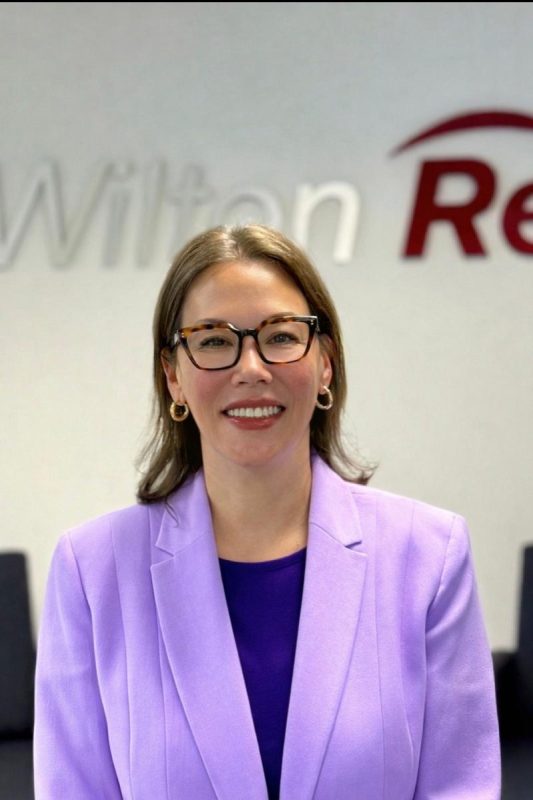
Sylvia Oliveira will never forget a conversation with a work colleague that provided powerful motivation on a career path that has led her to the C-suite of a Bermudian reinsurance firm.
Ms Oliveira recalled: “He said to me, ‘I don’t think a woman should be CEO and be a mother at the same time.’ I’m thankful for that comment, because it definitely lit a fire.”
At the time, the man in question was vying with her for a role that she successfully landed. It was not the first time Ms Oliveira had encountered this type of bias during her career in the male-dominated world of reinsurance.
But the attempted put-down served only to double her determination to succeed.
After 13 years as chief executive of Wilton Re Bermuda, while also raising two children, Ms Oliveira’s record speaks for itself.
Her tenure has brought significant growth at Wilton Re Bermuda, one of the earliest established of Bermuda’s new wave of life reinsurers. The parent company was founded in 2004 and is owned by the Canada Pension Plan Investment Board, the investment arm of one the largest pension funds in the world. Today the Bermuda company has a balance sheet of more than $20 billion.
As she looks back at more than 30 years in insurance, Ms Oliveira can see clearly the important elements that helped her to succeed in business as a woman — including a solid base of technical expertise, the development of strong communication and leadership skills, mentors and supporters, networking (especially with other women) in the industry, and a supportive partner.
“I’ve been lucky to have had some incredible male mentors and allies, people who made me feel heard and judged me on my merits and my work, and that was key for me,” Ms Oliveira said.
“But I’ve also had the flip side where I’ve been judged differently as a woman, in either overt or subtle ways.
“I’ve learned over the years to gravitate towards people who are allies and avoid the negative-energy people.”
Climbing the ladder
Ms Oliveira grew up in Connecticut and studied mathematics and economics. To become a qualified actuary takes an average of seven to ten years, with the support of an employer through the series of exams. In Ms Oliveira’s case, that employer was US life insurer John Hancock in Boston.
After she moved to Bermuda as a life actuary in 1999, she added the chartered financial analyst designation to her professional qualifications, further strengthening her credibility on the intersection of life insurance risk and investments.
“Building that base level of technical expertise is so important — perhaps especially for women — to establish credibility and to get your foot in the door,” Ms Oliveira said.
Moving up the ranks and managing a team requires different skills and a broader perspective than she had as an actuary focused on the numbers.
“I’m a very technical person, but moving into a leadership role meant lifting my head out of the spreadsheets and seeing the bigger picture, how the business works and how decisions are made,” she said.
“I put my hand up for projects and worked a lot of hours, and I also deliberately worked on my softer skills — how to motivate and influence people, and good communication.
“What actuaries do is complex and nerdy, a lot of numbers and formulas. Being able to distil that into a simplified format to present to management and peers is really important, so that people really understand what we’re doing.”
Ms Oliviera said she benefited greatly from guidance that helped her advance into a managerial role while working for ACE, now Chubb.
“I wasn’t part of a formal management programme at ACE, but a couple of targeted coaching sessions helped me make that shift,” she added.
Multiple surveys have shown that parenthood takes a disproportionate toll on women’s careers, reflecting the societal expectations that mothers carry the bulk of the parental load.
Ms Oliveira remembers the early years of motherhood as “an intense period, coinciding with the global financial crisis and demanding professional responsibilities”.
She added: “I was working crazy hours, I had a newborn and a lot of responsibility at work, but I did what needed to be done.”
Vital support
Ms Oliveira has heard the stories of how other female high fliers have managed to balance family and career, when attending the several professional women’s groups she belongs to.
“Some women have a supportive, stay-at-home husband; some women have a power husband and a full-time live-in nanny; sometimes their mother lives with them,” she said.
“Accepting help was the common theme that I heard, and I adopted that advice. Having some kind of support is really important.”
Groups such as Women in Reinsurance, which last year presented Ms Oliveira with its Woman of the Year Award, provide an important platform for leadership development and networking.
“I think women tend to learn from each other, and creating opportunities for these conversations is essential,” she said.
“There’s always a great turnout and I meet amazing people at every WiRe event.”
She also suggested that a recent influx of female executives could have something to do with the island’s unique environment.
“This is my own theory, but I think the safety of Bermuda, relative to other jurisdictions, the ease of getting around and the beauty of the place create an environment that many female leaders find attractive,” she said.
Outside work, Ms Oliveira has found multiple interests. She plays violin with the Bermuda Philharmonic Orchestra, serves as president of the Bermuda chapter of the Chaîne des Rôtisseurs, an international culinary society, serves as president of Actuaries of Bermuda, a professional community and networking group, and is a board member of the asthma charity Open Airways.
“These groups all bring people together,” Ms Oliveira said. “That’s part of what I really love about Bermuda – a special sense of community that you don’t find in other places.”
