
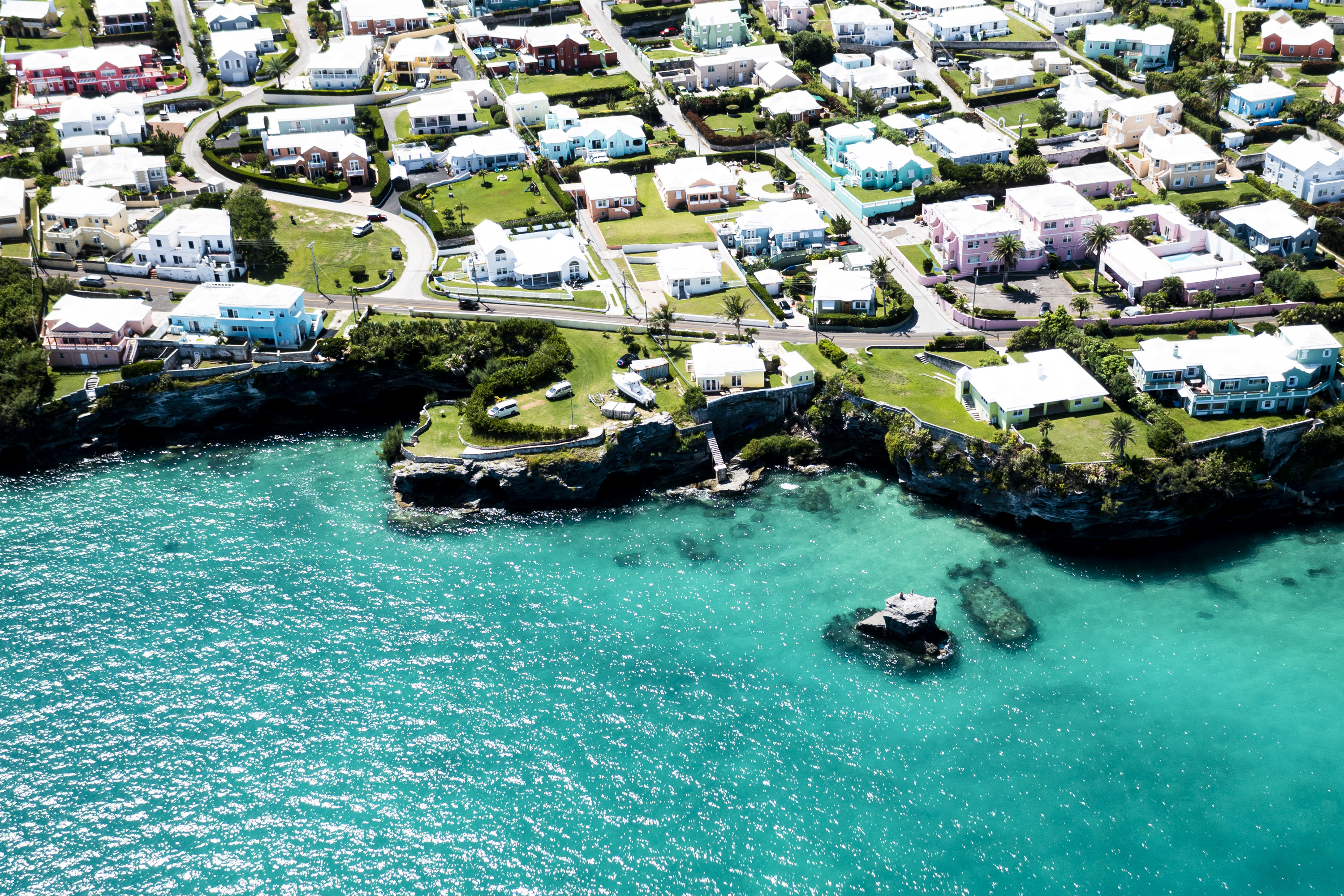
When realtor Ben Rego recently listed a house for sale in Devonshire for $985,000, he knew there would be a lot of interest. What he hadn’t reckoned on was just how much.
“I had 57 tours,” he said. “It was a challenge and so we ended up doing, my assistant and I, two open houses, one on one Sunday, one on the next. My prior record for sales for anything like that was 36.”
The property sold, subject to contract. Many offers came in “way, way lower” than the asking price, even from those approved for mortgages of $900,000-plus. Mr Rego said prospective buyers putting in low bids were unlikely to be successful in the current buoyant climate.
“They say the best time to buy real estate is yesterday, because long ago maybe it would have been worth a figure in the $700,000s but the market, just like the stock market or anything else, it goes up and down and it’s supply and demand.”
Mr Rego said the interest in the Devonshire property was indicative of the state of the island’s residential housing market, with its serious lack of inventory — particularly in the affordable and mid-priced brackets — and ready supply of buyers and renters.
“It’s been interesting because we’ve actually had, even with less listings, more transactions [in 2025],” he explained. He doesn’t necessarily expect that to change in 2026.
“Definitely, over the last few years and to this very day, when we are listing great properties at certain price points, in certain locations, they are going to absolutely fly off the shelf,” he said.
Mr Rego, agency manager at Rego Sotheby’s International Realty, predicted that land for residential development would be harder to come by, with most lots at Riddell’s Bay in Warwick, the Pampas Estate in Smith’s and White Crest Hill in Hamilton Parish having been snapped up.
“There’s going to be a significant reduction in the amount of land sales going forward, almost indefinitely,” he said.
“We’re going to go back to seeing hardly any land sell because there’s not much [in] 21 square miles. There are hardly any further opportunities unless people carve off a section of their own property.”
Mr Rego suggested there was little incentive for developers to build affordable housing here because of the “significant rise in construction costs, materials and labour”.
He said of those building new properties: “Why would they rent it or sell it for a low cost when they’re not going to be able to recoup their own build costs?
“That’s something that needs to be figured out with the Government, for different incentives [for developers].
“There’s a lot of derelict properties … on the island, so maybe there’s other opportunities for Government or charity; maybe public and private sectors can do something.”
Alex DeCouto, co-chairman of the construction division of the Chamber of Commerce, suggested the Government needed to get inventive to deal with the dearth of affordable housing.
“It is just not possible to develop housing at affordable prices in Bermuda,” he said. “Incomes have not kept up with prices. All the usual incentives — duty relief, land tax, stamp duty, etc — would not even make a dent in it.
“This is why no one is developing homes at all. Even the luxury houses tend to be detached from feasibility — i.e. the cost of land plus construction frequently exceeds resale value. They get built because they can afford it anyway.”
Mr DeCouto, president of construction firm Greymane, added: “The only solution is for Government to play a significant role in housing development.
“They should follow the Singapore model. The Singapore Housing and Development Board build subsidised public housing and over 80 per cent of residents in Singapore live in one of these units.”
Mr DeCouto said timely statistics were hard to access so he focused mostly on high-level information about permitting from the Department of Planning when making predictions for construction for the coming months.
“Planning applications, happening six to 12 months before work starts, are seeing a slight decrease this year, which may be indicative for next year,” he said.
“Building permit applications, happening two to six months before work starts, are tracking slightly above the two-year average, broadly indicating we are relatively busy.”
Mr DeCouto noted that the 2024 employment survey showed only a 4 per cent increase in employment in the industry over 2023.
“For us to get to 2008 levels of employment in the industry there would have to be a 61 per cent increase, to put things in perspective,” he said.
He anticipated that the first half of 2026 “will be as busy as we have been for many years”.
“The two office buildings in town and work at Southampton Princess and Rosewood will be sites that are driving this,” he added. “The second half of 2026 is hard to picture.”
He said a lot was still unknown about certain projects, such as the Fairmont Southampton.
“They have permission for lots more residences but it’s unclear when and at what pace they will build them.
“There is an expectation that Government will be looking to invest proceeds of CIT [corporate income tax] in capital projects. I will be waiting to hear their intentions.”
Mr DeCouto urged the Government to continue to be co-operative in relation to work permits for developers because “our workforce is shrinking” and to invest in the planning department.
“I am seeing that AI is making the work of code compliance and plans review much more efficient and we need to invest in that technology,” he said.
He advised the Government: “Continue to make the island attractive to foreign investment, then stay out of the way!”
