
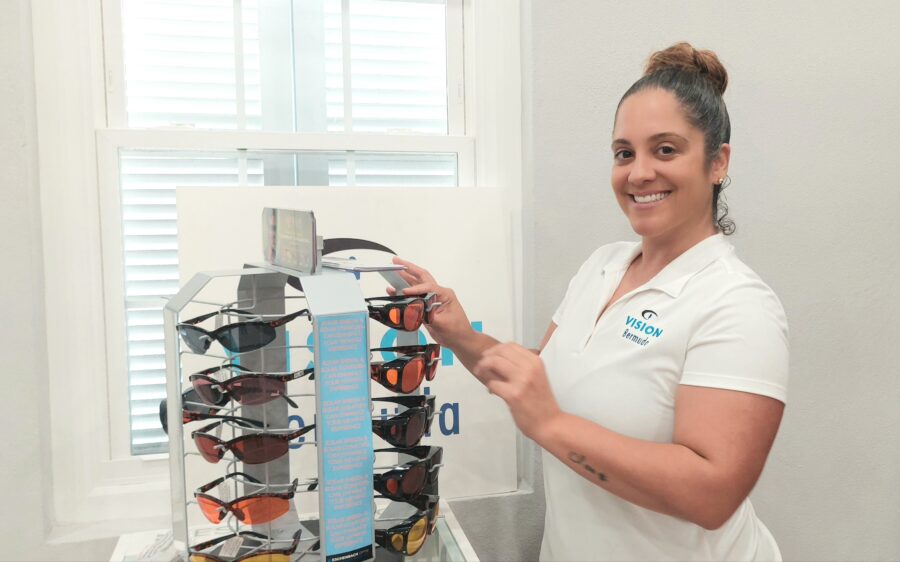
For hundreds of Bermudians living with partial sight or vision loss, daily life is full of invisible barriers.
From reading public signage to securing employment or simply getting around safely, challenges abound – and are often made worse by a lack of understanding.
That’s something Vision Bermuda (formerly Bermuda Society for the Blind) is determined to change.
Under the leadership of executive director Erica Ingemann, the charity is raising awareness, breaking down stigma, and helping people with vision loss live with confidence and independence.
“Vision impairment is more common than many realise and can affect anyone, at any age. In Bermuda, the leading causes are glaucoma, diabetic retinopathy, and cataracts — all of which can cause significant sight loss if not diagnosed and treated early,” Ms Ingemann said.
Access to regular eye care and the high cost of treatment can make early intervention difficult for some, leading to preventable blindness – but there is hope.
“With appropriate rehabilitation, adaptive technology and community support, people who are blind or visually impaired can continue to live independently and contribute meaningfully to society,” Ms Ingemann said.
“Greater public understanding and accessible environments are essential,” she continued. “Simple changes like clear signage, consistent lighting, readable fonts and offering verbal assistance can make a meaningful difference.”
Reaching out
Raising public awareness is one of Vision Bermuda’s core missions. The organisation runs outreach presentations, media interviews and social media campaigns, and participates in community events such as World Sight Day, and local health fairs.
“We actively work to increase understanding and reduce stigma around vision loss. Through our monthly radio show, Vision Talk, and our community meeting series, Vision Insights, clients and professionals can share lived experiences and promote inclusive practices that benefit the wider community.”
Vision Bermuda also advocates for accessibility and equal rights, ensuring the voices of those with vision impairment are represented in public discussions and policy planning.
“By creating open conversations and promoting understanding, we help shift the focus from disability to ability.”
While official sight loss data is limited in Bermuda, the issue is far more widespread than many assume.
According to the most recent available data, from a 2009 national survey, between 107 and 295 people were living with blindness or significant vision loss.
Ms Ingemann said: “The true number is believed to be considerably higher today due to an ageing population and rising diabetes rates.”
Since 2016, Vision Bermuda has supported more than 700 clients, offering a clearer picture of how common vision impairment has become.
“This isn’t a small or isolated issue,” Ms Ingemann warned. “It touches families across Bermuda.”
Providing hope
One of their clients, who testified anonymously, lost his sight suddenly – and everything changed.
“I was diagnosed in 2023 with optic nerve atrophy – I lost all vision in my left eye and have limited vision in my right,” he recounted.
“It was a dramatic change. I couldn’t drive anymore, and I had trouble seeing in both bright and low light. It really turned my life upside down.”
After informing his employer and eventually leaving his job, he reached out to Vision Bermuda. “They took all my information and got the ball rolling right away,” he said. “I started doing cane training, software training – learning how to use text-to-speech and magnification on my computer. It was very, very helpful.”
He also attended rehabilitation and group sessions. “One session we made bread,” he laughs. “That was interesting! But most of all, it helped to know you’re not alone. Sometimes you think you’re the only one going through something like this – you’re not.”
Today, he’s back at work with a local maintenance company and remains hopeful for an office-based job – because being in one environment is better for his condition.
“I’m grateful for Vision Bermuda and the staff there,” he said.
Vision Bermuda offers a range of programmes designed to help people regain independence and confidence. Each service is tailored to individual needs and offered at little or no cost.
Core services include vision rehabilitation, low vision clinics, assistive technology training, peer support and group activities that build social connection. The organisation has also introduced professional counselling and family support groups to address the emotional side of sight loss.
“Living with vision loss can be life-changing, but it doesn’t have to be life-limiting,” Ms Ingemann said.
“We’re here to bridge the gap between diagnosis and independence – to make sure every person has the tools, skills and support they need.”
Vision impairment often becomes a barrier not because of the condition itself, but because environments are not designed inclusively.
“In employment, tasks that rely heavily on visual input can be challenging without accessible technology or workplace awareness,” Ms Ingemann said.
“In education, students may struggle to see materials or follow lessons if resources aren’t adapted. And socially, simple things like recognising faces or navigating crowded spaces can lead to isolation.”
Their unnamed client experienced this first-hand.
“I went for a job interview and made it to the final stage,” he said. “Once I told them about my low vision, they turned me down. It was upsetting – I knew I could do the job. That’s when I realised how much misunderstanding there still is.”
Ms Ingemann said: “With the right support, people with vision loss can participate fully and equally in every aspect of life. The barriers are social and structural – not personal.”
Keeping Bermuda beautiful sometimes hides its accessibility problems.
“Uneven sidewalks, limited tactile street crossings, and a lack of accessible signage make everyday navigation difficult and, at times, unsafe,” Ms Ingemann explained. “Public transport can be a challenge too, especially for those who rely on clear audio or visual cues.”
Through partnerships with healthcare professionals, government agencies and the corporate community, Vision Bermuda is working to address these gaps and advocate for long-term change.
“We’re building a more informed and compassionate Bermuda – one where everyone, regardless of sight level, can live confidently and with purpose,” Ms Ingemann declared.
Despite the challenges, there is optimism.
“Technology is changing what’s possible. From screen readers and magnifiers to AI-powered apps that describe surroundings, accessibility tools are transforming lives.
“But awareness still matters most. The more people understand vision impairment, the more inclusive Bermuda will become.”
