
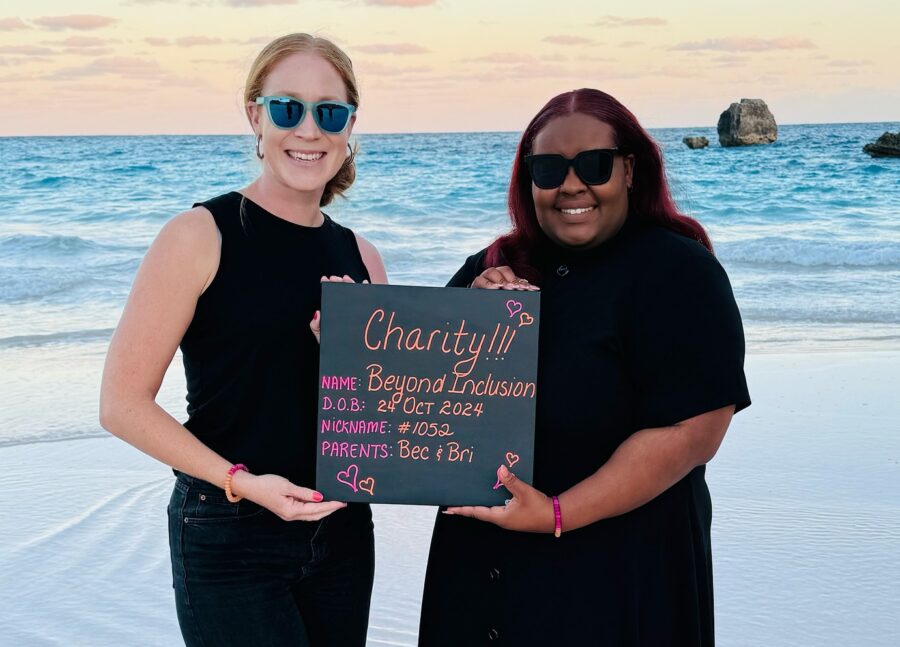
Brianna Ball-Roach describes her and Rebecca Lawrence, joint founders of Beyond Inclusion, as the “fun guys”.
But it’s clear upon meeting the pair that they are deadly serious about the work their fledgling charity does.
Formed in late 2023 and having gained charitable status last year, Beyond Inclusion aims to ensure those with disabilities and mental health issues can participate in all the best bits of life — things like cinema trips, beach outings, restaurant meals and holiday events.
In other words, the activities most people take for granted but that are often inaccessible to those with support needs.
Ms Lawrence explained why the pair launched the organisation after both returned to live on the island.
“I have a background being a teacher and working with individuals with support needs in the UK and Brianna has a background within mental health, based in the US, so we were very passionate about those two areas,” she said.
“We were just talking about the gaps that we saw [in Bermuda] and we noticed gaps within recreational and social opportunities.
“We saw a lot of academic supports and therapeutic supports but not really that fun factor that really pushes your quality of life to be better.”
Beyond Inclusion was created to fill the void and its founders, who both have full-time government jobs and run the charity in their spare time, have spent the past two years building an itinerary of regular events.
That includes an annual Hallowe’en Trunk or Treat, a spring fling at Easter and a ‘Tis the Season get-together, which includes a meet-and-greet with Santa.
Many participants are youngsters but all Beyond Inclusion activities have elements to appeal to adults.
“We don’t want to infantilise anybody,” said Ms Lawrence.
Ms Ball-Roach added: “We’re just here to meet the social and recreational engagement needs of all individuals of all ages with support needs.”
Playing catch-up
The pair’s contention that social interaction improves quality of life is backed up by the World Health Organisation which, as Ms Ball-Roach explained, recognises “social isolation as an epidemic, as a health issue that leads to decreased life expectancies”.
She added: “We already know studies show that people with support needs have decreased life expectancies in general.
“So … if we can help to bridge the gap, if we can help to increase someone’s quality of life … that’s exactly what we’re there to do.”
Both women nod vigorously at the suggestion that Bermuda is somewhat “behind the times” in relation to accessibility.
They describe public transport as “completely inaccessible” due to a lack of ramps and the design of most bus stops.
Shops are a problem too. Ms Lawrence said: “The amount of stores you go to and they have a tiny lip off the sidewalk to get in the doorway and then that means that we can’t use it, because if you’re in an electric chair, you can’t tilt the chair, and most of our participants are in an electric chair.”
Ms Ball-Roach described one of the organisation’s “biggest struggles” as coming up with new activities, precisely because of such challenges.
“At least twice a month, we have some form of outing in the community where we go out to movies, we’ve done pizza making, we’ve done a bunch of boxing matches … just anything that everybody else goes to,” she said.
“Our criteria though is that wherever we go has to be accessible. That is both a challenge that we hold ourselves to, but also kind of a challenge to the community, because there are a lot of things that we would like to be able to do, but because some of our participants cannot access them, then we’re not going to go.”
Physical barriers are not the only problem. A Human Rights Commission study earlier this year found that societal prejudice had a detrimental effect on inclusion.
“People with disabilities reported being met with punitive, dismissive and discriminatory treatment and attitudes when attempting to navigate life in Bermuda,” the HRC report said.
Ms Ball-Roach said: “That report is quite long but it is quite telling. It’s quite detailed and it just shows you how much work there is to be done.”
You can make an impact
Ms Lawrence said Beyond Inclusion embraced the tagline used by the HRC in relation to those with disabilities and support needs: “Nothing about us without us.”
She explained: “We’re very lucky that 50 per cent of our board are individuals with lived experiences of having support needs or being a carer for somebody with support needs.”
With that in mind, the charity’s board responded collectively to questions for this article, noting that those with disabilities — visible and non-visible — are at greater risk of social isolation, as are their carers.
“We recognise that staying connected can be difficult due to the lack of inclusive and accessible options and more work must be done to remove these barriers,” the board said in a statement.
It explained that there are many ways the able-bodied can help bring about change, such as employers working with those with support needs during the hiring process to make “reasonable accommodations” or architects and planners addressing lack of access.
The board urged those with support needs to “stay involved in community groups, clubs or programmes that match your interests, such as Beyond Inclusion or other local disability-related organisations. Or consider joining online groups.”
Ms Ball-Roach said the island had more than 3,000 people with disabilities “and that’s just the ones that Bermuda has been able to collect information on”.
She added: “I think that just goes to show that we have at least 3,000 opportunities to impact someone positively, right?”
Social isolation for those with support needs, she said, was an issue the whole country should be thinking about.
“We want to drive home the fact that it shouldn’t be that it has to happen to you or someone that you care about for it to be something that you care about.
“This is, at a very basic level, a human rights issue.”
- Beyond Inclusion can be contacted at [email protected]
