
The first time I realised how difficult the City of Hamilton was to get around when not just myself on two able feet, was when I became a mother and had to navigate pedestrian crossings with a pushchair.
I would go down the ramp on one end only to find I had to navigate a high kerb at the other. What must it be like for people in wheelchairs, or who rely on walkers or canes to get about, I wondered?
My experience was more than ten years ago, and accessibility in the City has improved since then. However there are still a number of mobility hotspots, which can be at best inconvenient, and at worst, dangerous for people with mobility challenges.
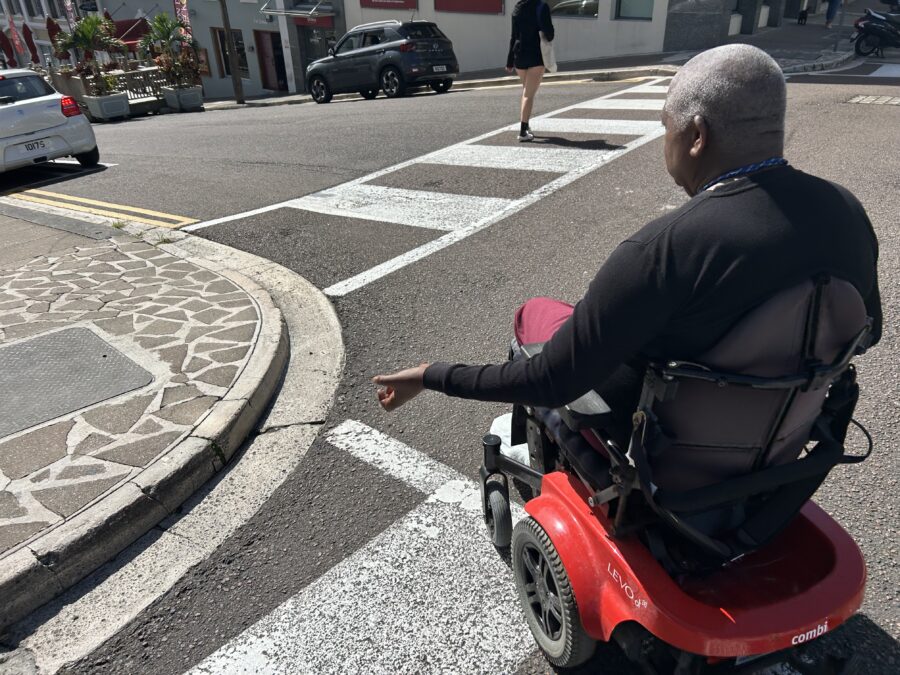
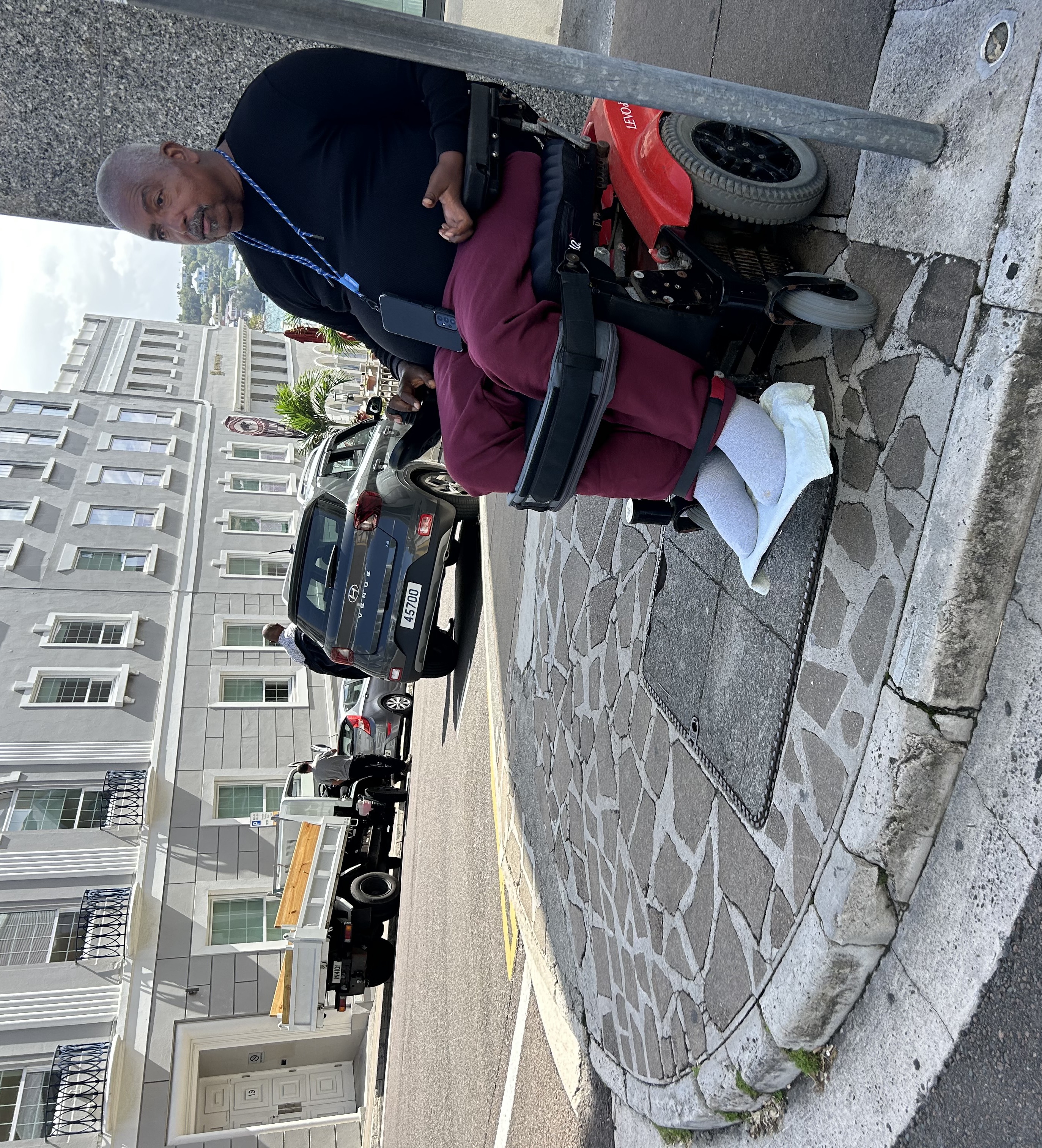
Wheelchair user and disability advocate, Keith Simmons, took me on a tour of Albouy’s Point, Front Street, Reid Street and Queen Street, explaining where some of these hotspots are, where improvements need to be made, and what it is like to experience Hamilton in a wheelchair.
 Pedestrian lights
Inevitably, moving around a city involves crossing roads, with some like Front Street being more tricky than others and not just for those who rely on wheels. How do the visually impaired know when it is safe to cross at the lights?
Some beep, and others, such as the ones on the corner of Front and Court Streets have a cone for your hand beneath the operating box, which twists when it is safe to cross the street. Not all pedestrian lights have these devices, however, including the busy junction where Burnaby Hill meets Front Street, but the City is working on this.
“Those junctions are scheduled to be upgraded as part of the City’s ongoing traffic-light replacement programme,” confirmed a City spokeswoman.
“Once the new systems are installed, they will include the standard accessibility features such as rotating tactile cones.”
These are safer than the “audible chirpers”, they explained, because, “in areas where several crossings are close together, the sound can be confusing to visually impaired pedestrians as it may be unclear which crossing the chirp is coming from.”
Pedestrian crossings
There are also still kerbs, lips and other obstructions at a number of pedestrian crossings. On one side of the crossing at the top of Queen Street, a large bin makes it difficult to get a wheelchair up the ramp; and at the corner of Queen and Reid Streets, Mr Simmons has to abandon the zebra crossing, and the pavement, and roll onto the road due to a deep grate and scaffolding.
“That water grate, the drain needs to be removed. Ladies actually catch their heel inside of it,” he warned before smiling and adding: “I poppa wheelie over there,” referring to the steep ramp he has to negotiate to get onto the pavement.
Getting from Point Pleasant Park at Albouy’s Point onto Front Street also involves him using the road.
Does he find this nerve-wracking?
“I feel safer driving across the road than going across a pedestrian [crossing],” he surprisingly answered.
“I’ve been almost demolished a few times on a pedestrian. It happened to me here last Sunday. People drive through red lights and don’t care. A taxi driver stopped right there to the light. I went across and two bikes came around the taxi and just kept driving. The tourists in the taxi screamed. They couldn’t believe it.”
Thankfully, Mr Simmons was fine, if a little shaken.
Other areas with difficult or inaccessible crossings include the corner of Burnaby and Reid Streets and the crossing outside the Cabinet Building on Court Street.
Building access
If a step is the only way in, Mr Simmons can’t go in, and there are a number of buildings that don’t have ramps or other forms of assistance to combat that.
This seems to be a basic consideration when a building is to be renovated, but some building owners aren’t willing to make that investment, which he thinks is short-sighted.
“I’ve had visitors come to Bermuda from the UK and the US and they’ve asked to go to certain places and they get to a restaurant [and say] ‘Sorry we fight against this back home so we’re not going here. Take me somewhere accessible.’ And I’m talking like a room of ten people, so long-term, could benefit your facility.”
He cites Quebec City as an example of where an old, hilly city can still be made accessible.
“The old city’s protected, but what they were doing there can very easily be done in Bermuda.”
They use platform lifts in some areas and in others they levelled entryways.
“That inch or two access in the doorway made a difference to get through and it worked really well,” he explained.
Future changes
The City spokeswoman confirmed that accessibility remains a “major focus” and they are “continually seeking ways to improve both our physical and digital environments”.
Examples include more disabled-parking bays, upgraded kerb cuts and tactile paving to assist visually impaired pedestrians. The City has also launched a redesigned website, which has “clearer navigation and quick links to high-demand services such as events, parking and permits, making online access easier for those who may face mobility challenges”.
Small changes, big difference
Mr Simmons would also like to see more markings on glass doors for the visually impaired, along with a ramp and a longer railing at the Point Pleasant Park public dock, to make it safer and available for everyone.
He would also love the ability to access Barrs Bay Park directly from Albouys Point, as the ramp from Pitts Bay Road is “very steep”. On the day we visit, the gate preventing this is open so he can, but that’s not always the case.
The City encourages anybody having difficulty with crossings or pavements to contact them on 292-1234 or [email protected].
“We are always willing to work collaboratively to find practical solutions,” the spokeswoman said.
