
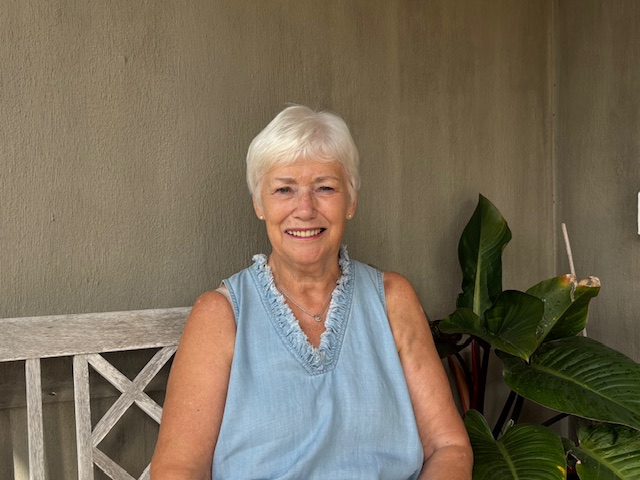
Susan Garland is a self-confessed “worrier about health things”, so as soon as she was eligible to start having an annual mammogram, she went religiously.
It was lucky that she did.
If she hadn’t, her cancer could have become much worse, because in 2018, when she received the call to go back in for an ultrasound and then a biopsy, she had no noticeable symptoms at all.
“I had no lump. I have no idea what they saw but it was all found on the mammogram,” said Ms Garland, 80.
What they saw turned out to be stage one breast cancer, which she described as “very small”. Stage one means that the cancer is early stage and either only in the breast tissue, or might be found in lymph nodes close to the breast.
On hearing the news, Ms Garland’s reaction wasn’t one of panic, which surprised her.
“I took it all in a much better way than I thought I would,” she said.
She received a lot of support from her family, in particularly her daughter, Caitlin, who “went straight into practical mode” and took a “let’s get this sorted approach”.
After the diagnosis was confirmed, the next step was surgery followed by radiation treatment. She was given the choice of three surgeons by her GP and made her selection after receiving advice from a friend who had worked at the hospital for many years.
The cancer was removed from her breast during a day surgery, leaving Ms Garland “uncomfortable” and “tender”; her sister came over from the UK to help her.
Comfortable process
Following surgery, she also required 18 daily radiation treatments, each lasting 15 minutes, which, because of her claustrophobia, she was very nervous about. She credits the “amazing” staff at Bermuda Cancer and Health Centre however, as well as the “wonderful Dr Chris Fosker”, with helping her to overcome her fear and making her feel comfortable.
“I was a little concerned about where I was going to be, because I knew this was on the lower level of Cancer and Health. So, I asked to see the unit, which they were fine with, to see what would happen,” she said.
“It’s a large space and, although you’re in there on your own, they are on the other side of a screen, although you can’t actually see them, and they’re talking to you all the time so I was absolutely fine.”
Ms Garland also found the radiation treatment process easy and convenient, particularly as she volunteers at the Red Cross thrift store just down the road.
“I would pop in, have my treatment and go back,” she recalled.
She also recalled feeling mostly OK during these treatments, except for during her final week, where she “definitely felt tired”.
Another side-effect of her treatment, she added, is that her breasts are now slightly different sizes, but that doesn’t seem to bother her.
“I’ve got one much smaller than the other now,” she smiled. “I got one of those things that you can put in your bra [but] I’ve never used it.”
Get screened!
When Ms Garland looks back on her cancer survival journey, it’s generally with a positive attitude. Her advice to anyone who has recently been diagnosed is to “just not be intimidated by what’s to come because the unit, and Cancer and Health, it’s just amazing”.
She said: “Everybody says the same thing about it. They’re just great. The staff are wonderful. The area that you’re in is very relaxing. There’s nothing to be afraid of. I hate hospitals so the hospital bit, I was definitely intimidated by, but not by the radiation side of things.”
Her most important piece of advice, however, is to anyone who might not be up to date with their annual mammograms: start having them straight away. That’s the only reason her breast cancer was caught as early as it was.
She also urged people to take advantage of the fact they’re available annually.
“I’m just astounded that in places like the UK, it’s every three years and also, after the age of 71, they don’t offer it unless you ask,” she said.
Ms Garland was 73 when she was diagnosed with breast cancer.
The earlier cancer is diagnosed, the higher the chances of survival. According to Cancer Research UK, when breast cancer is caught at stage one, “most women (almost 100 per cent) will survive their cancer for five years or more after diagnosis”. This goes down to 90 out of 100 for stage two, 70 out of 100 for stage three and “more than 25 out of 100 women” for stage four.
Ms Garland’s breast cancer was caught early, her treatment worked, and she has been cancer free for nearly seven years now.
She still goes back for her mammogram each year.
“It’s always in the back of my mind, I wonder, but I think that’s for a lot of people,” she said.
Her daughter also never misse
