
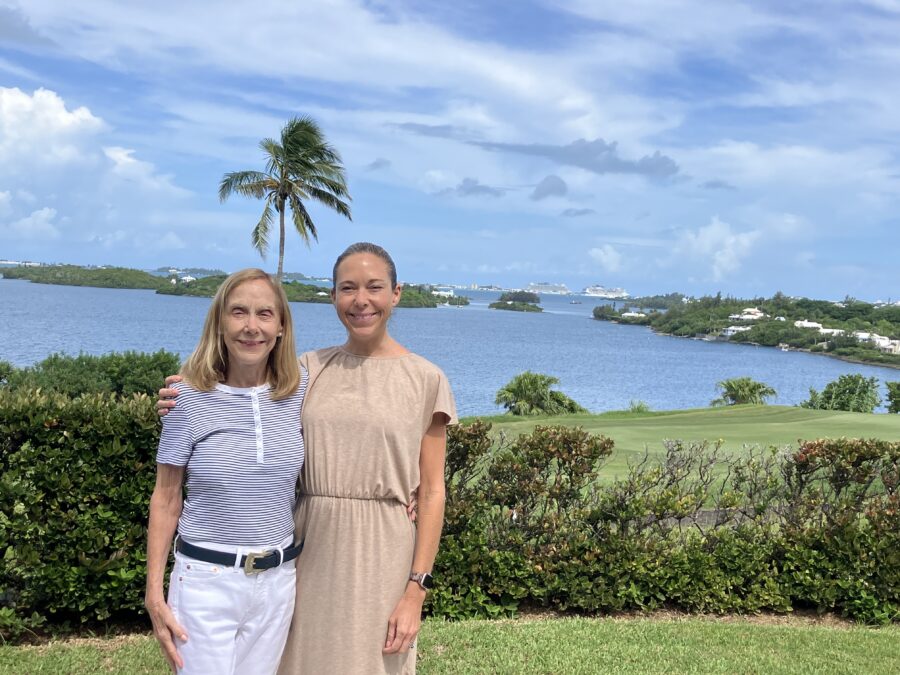
Anne Kast is one of those people in Bermuda that everyone seems to know.
Ms Kast may not remember someone’s name when she bumps into them – but they invariably end up hugging anyway.
“I go into the food store, and somebody goes, ‘ANNNE!’ – and I can’t remember their name,” said Ms Kast, who was diagnosed with dementia two years ago.
Ms Kast responds by apologising, telling the acquaintance she doesn’t remember their name, and asking for a reminder.
“And people love it,” she said. “That works really well.”
Ms Kast’s positive spirit is intentional.
“I work on that. I really do. You have to accept things, and that’s helpful. I’m so fortunate with my family. Oh my gosh. They get all the thank yous.”
Dementia is a disease fraught with challenges and heartache, but the 78-year-old has tackled it the only way she knows: head on.
It’s an unsurprising approach from someone who enjoyed a remarkable career as a trailblazing businesswoman – she was the first female private investment manager in Bermuda, founded the successful Kast Investment Management in 1991, and worked a key role at the Bank of Bermuda for 17 years prior.
Ms Kast was also the first person in Bermuda to receive the drug Leqembi, which slows the progression of Alzheimer’s.
A long road
The road to access the medicine was exhausting and extraordinary.
About seven years ago, she told her doctor she was noticing some difficulty with words and language. She underwent an assessment, happily passed it, and the word dementia was never mentioned.
“I kind of went on my way, not worrying about anything,” she said. “The years went by. Things changed.”
She saw a specialist in New York in 2020 and was diagnosed with mild cognitive impairment. But the Covid-19 pandemic meant she was unable to follow up quickly.
In 2023, she was assessed again, and this time her GP confirmed she had dementia.
Daughter Elisabeth Kast recalled: “That’s when everything changed. It’s extremely difficult news to receive.
“We were left to figure everything out for ourselves. Luckily, our family in the US knew of a reputable neurologist, so we went and had her assessed in Virginia.
“The neurologist recommended a new FDA-approved medication, Leqembi, which has to be given intravenously.
“I was like, this is great, but how the heck are we going to get this in Bermuda? Do they know about it here? Who would be able to administer it intravenously?”
They met with a psychiatrist, who agreed Leqembi was suitable and safe, and would slow down the disease’s progression. He enlisted the support of CG Pharmacy, who worked with Ms Kast’s insurance company to bring the drug into the island; once Ms Kast was approved, a “fantastic doctor” agreed to administer it every two weeks. She still goes to Dr Arlene Basden at Bermuda Medical Specialties Group every two weeks for the infusions and reports, receiving incredible care while she’s there.
“At the beginning, we had to figure this all out by ourselves,” Elisabeth said. “No one said, now that she has dementia, this is what you need to do.
“It was a six-month arduous process, with doctor visits, navigating the health system. On top of that, you’re dealing with the emotional aspect of your mother receiving the diagnosis.”
The Bermuda Government this month moved to address the issue by launching an integrated care pathway that aims to ensure families get appropriate information, services and support.
The Kasts welcomed the development, acknowledging that many people with dementia do not have the resources to pursue top-class help like they did.
Love and support
The Kasts acknowledged that many people with dementia do not have the resources to pursue top-class help like they did.
Elisabeth said: “I think about the people in Bermuda who are in the early stages of the disease who aren’t able to access these treatments that are available. It’s upsetting.”
Ms Kast’s dementia progression may now be more controlled, but there remains no cure for dementia.
She said: “It comes and goes. Waking up in the morning is the hardest time, I feel terrible. As the day goes on, it gets better and better and then I’m back again. I sort of live with that. That’s the downside.”
She receives support from Dementia Bermuda through attending their fitness classes with other individuals with dementia.
“That’s great. I love that. It’s excellent. It gets crowded and there’s all kinds of people in there, and I love the girl who’s leading it.”
Dementia has also brought the family closer together.
“I’ve never had this kind of love,” Ms Kast said.
“I’ve had a great life. That’s what keeps me going. When I’m really down or upset or whatever I just say, hold on, you’re lucky with what you have.”
Elisabeth added: “In many ways, her diagnosis has brought us closer, because she relies on me more, but we also treasure our time together more, having to navigate so many things together.
“I’ve really admired how my mom has coped with this. She’s probably coped with it better than me. It’s brought us closer, so for that I’m grateful.”
Elisabeth believes her mom can serve as a role model for others at the early stages of their dementia journey.
“She did the right thing,” she said.
“She went multiple times when she started noticing symptoms and sought opinion and assessment. She didn’t run away from it.
“Because she was able to get a diagnosis early, she was able to get treatment that wouldn’t have been available if we had waited.
“Our advice is to get assessed as soon as possible. The sooner you know, the better. Don’t wait. Don’t run from it.”
