
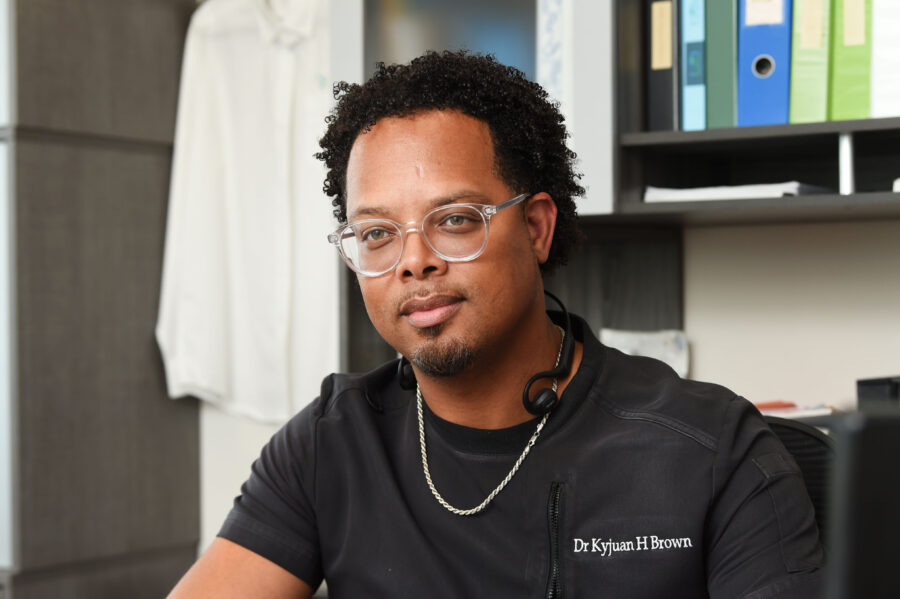
In October 2024, Kenton Trott and Gavin Smith each underwent a hair transplant at Dr Brown’s Hair Clinic at Northshore Medical & Aesthetics Centre in Devonshire.
Now, they are not only regularly stopped on the street, questioned and complimented, but they are also inspiring other men to be more open about their hair loss and seek treatment.
When he was 21, Mr Trott, a barber and owner of Luxury Cuts Studio on Reid Street, noticed his hairline was regressing. In total, it regressed 3cm.
For Mr Smith, 46, the hair loss was more dramatic: “I had my early recession around my early 20s and before that I had long dreads. So, I just gave up and started shaving my head. I didn’t think it was possible to bring my hairline back.”
This all changed in October 2024 when, after a consultation with Dr Kyjuan Brown, founder and medical director of NMAC, both men went ahead with their recommended procedures and medications, and now proudly show off full heads of healthy looking hair.
Because 40-year-old Mr Trott’s hair loss was less advanced, Dr Brown only had to transplant the frontal line. He was able to restore the crown using medical intervention, which involved a DHT blocker in the form of gummies and topical drops.
DHT stands for dihydrotestosterone, a hormone that stimulates the development of male characteristics, but is also associated with male pattern hair loss, which affects two-thirds of all men.
“I had the transplant and then followed up with PRP treatments and laser treatments,” Mr Trott said. PRP is platelet-rich plasma therapy, which uses the patient’s own platelets to stimulate hair growth. Dr Brown also offers phototherapy, mesotherapy, carboxytherapy and stem cell therapy.
Mr Smith had to have a larger transplant, 3,800 follicles in total, and then, like Mr Trott, had to follow up with PRP and laser treatments as well as DHT blockers.
“The first step is always restoration if we can. We want to be able to catch it early,” Dr Brown said. “So, for Kenton, he was able to keep that crown thick, but once that frontal line has gone, I can’t restore that to how it was when he was twenty-something. That’s going to be transplanted.
“Someone like Gavin, starting the restoration process would be futile because he was too advanced.”
Dr Brown initially didn’t even think transplant was possible, but after telling him to grow out the hair he had left, he found a good enough “donor area”.
“I’d been shaving my head with a razor for years, so I didn’t know how much hair I had on the sides, so that was a big challenge,” said Mr Smith. “I was asked to grow my sides out, which was a very ugly duckling period for me because I’d been used to being clean shaven,” he laughed.
How exactly do hair transplants work?
“It’s just like transplanting plants. You take one plant out of one pot and put it in another. For the hair, we transplant from one region to another,” Dr Brown explained.
In extreme cases, hair can be transplanted from other parts of the body, but usually follicles are moved from the back and sides of the scalp to the top and front.
“You have four times the amount of hair on your side as you do on your top,” continued Dr Brown. “So, when we take one of four, you’re not noticing any difference.”
The transplant operation takes six hours and is done under a local anaesthetic. Patients are also given medication to help them relax, so they aren’t moving around too much.
The operation is painless. The hardest part is the fact that you have to sleep upright for about 10 days afterwards. Mr Trott used a recliner chair and neck pillow to keep the back of his head from touching the chair. You also can’t wear helmets or hats.
Aftercare
Meticulous aftercare is vital to ensure the success of a hair transplant and avoid potential side-effects such as infections or keloid formations. Keloids are thick, raised scars.
“This is where aftercare is important,” Dr Brown emphasised.
“People that fly off to Turkey, or any other jurisdiction, you’re only there for four days, maximum a week. These keloids don’t normally show up until a month or two post-surgery.”
His patients come back to the clinic multiple times post-surgery.
“They come to us the immediate next day, and then the day after that. We do their scalp wash, remove their bandages, give them instructions on how to apply their creams and their medications, which helps prevent complications,” he said.
On day 10, patients have their scabs removed and continue to have once a month check-ups for three months. By month four, patients can expect to see results.
“It’s a level of excitement. I’m pretty elated,” said Mr Trott about when he first saw his transplant results.
Both men admitted, however, that there were some “scary” moments along the way, in particular when they saw how much had been taken off the back and sides of their scalp.
“I thought it was amazing that literally, within the week, it was filled in as if it was never removed. Just a bit of redness because of the procedure, but that dissipated over time,” Mr Trott said.
Patients will also experience what Dr Brown called “shock loss” about a month after the transplant, when the newly transplanted hairs drop out.
“I was given the forewarning about it, but it was still scary,” said Mr Smith.
Both men have been very open about their hair restoration and transplant journey and documented it on social media.
They are also happy to speak with anyone who is concerned about their own hair loss but may be nervous or embarrassed about seeking help: “There’s options available to restore your confidence one strand at a time,” said Dr Brown. “Don’t’ wait until the last moment.”
So, will Mr Smith grow his hair long again? “Oh yeah! That’s the goal!” he answered.
