
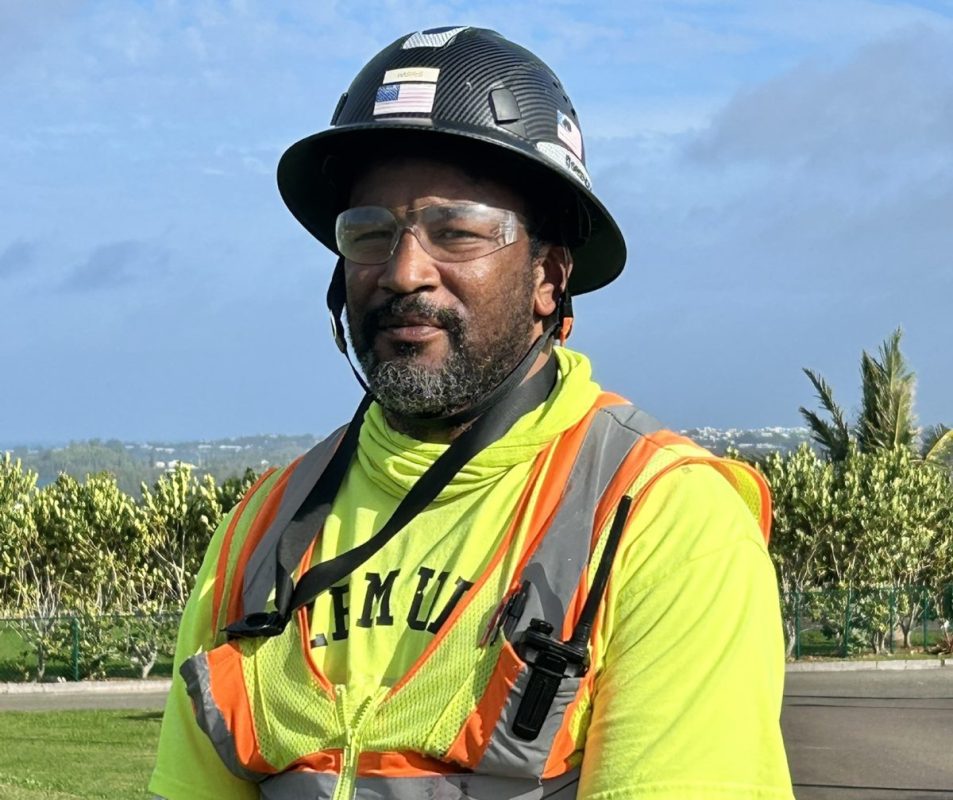
In an industry where risk is ever present and margins are tight, the true measure of professionalism is how well people are protected on the job.
The Bermuda Construction Safety Council, which was formed in 2018 in connection with the construction project at Morgan’s Point, offers training and awards in 50 trade categories.
It’s run entirely by volunteers and there is no membership fee – meaning cost is not a barrier to improving safety standards and networking opportunities within Bermuda’s construction industry.
Brendon Harris, the Council’s safety coordinator, said: “Our primary objective is to prevent all job-related injuries by providing and maintaining the safest possible working conditions for all our employees and subcontractors.
“We recognise that our most important asset is our people and that production, quality and cost efficiencies can be achieved through the daily application of standardised safety management systems and processes.”
Bermuda’s construction industry operates under workplace health and safety standards laid out in the Bermuda Occupational Safety and Health Act 1982 and the Bermuda Occupational Safety and Health Regulations 2009.
The Act specifies that it is the duty of every employer “to ensure, so far as is reasonably practicable, the health, safety and welfare at work of all his employees”.
It is the duty of employees to take reasonable care to protect safety and health of anyone affected by their actions or omissions at work.
Employees are required to cooperate with employers to follow the regulations. Workers also have the right to refuse work if they have reasonable cause to believe that conditions present an imminent and serious danger.
Benefits of investing in safety
Education in the construction industry is time and money well spent. The BCSC recommends viewing safety training as a long-term investment rather than a cost
Ongoing training remains one of the most effective pathways to safer jobsites and a stronger, more resilient construction sector for Bermuda.
According to the US National Safety Council, the economic cost of work-related deaths and injuries reached $167 billion in 2021 – underscoring the human and financial consequences of inadequate safety practices.
Mr Harris said: “The Bermuda legislation is relatively new, and we are working towards having standardised procedures on all jobsites.
“When you have standardised procedures such as morning briefings, daily stretches and continuing education, productivity increases and there also fewer work-related safety incidents.
“This benefits employers because fewer incidents means less time lost due to errors and work stoppages, which increases the likelihood that projects can complete on time and on budget.”
He noted that large projects involving international construction companies require all employees to have completed safety training before they are eligible to start work.
“When construction began on the new airport, for example, workers who had previously completed safety training were able to start working right away, but everyone else had to wait until they were able to complete the required courses before they were allowed on the jobsite,” he explained.
Strengthen safety through cross-training
Employees who work with heavy machinery depend on one another to remain safe. Because tasks are interconnected, everyone involved must share the same critical information and maintain constant communication.
Mr Harris said: “Moving large, heavy loads is a common occurrence on today’s jobsite. There are significant safety issues to be considered, both for crane operators and for any workers in proximity to them, because a crane operator never moves a pallet of concrete block alone.
“Each lift depends on continuous radio communication with people on the ground, whose clear, precise instructions are essential to manoeuvring the load safely and accurately, often into locations that are not visible from the crane cab.”
The people on the ground, known as bank workers, who have completed crane operator training become more effective communicators, and gain practical, hands-on insight into the operator’s responsibilities and decision-making.
This shared perspective enhances site-wide safety, reduces the potential for error, and can create a natural progression for bank workers to advance into crane operator roles.
Diversity and inclusion
Modern construction projects are increasingly diverse and inclusive, bringing together specialised workers from a wide range of cultural and linguistic backgrounds.
On many large job sites in Bermuda, the presence of non-native English speakers highlights the importance of clear, consistent communication practices and the use of standardised safety procedures.
The industry also employs far more women than is often assumed. Women now fill approximately 50 per cent of all office support roles, as well as a significant proportion of positions in architecture, surveying and engineering.
A safety culture that recognises and accommodates this diversity – through inclusive training, clear communication protocols and consistent expectations – strengthens shared accountability, reduces the likelihood of error, and helps ensure that safety is embedded in decision-making at every level of a project.
Mr Harris said: “Ultimately, keeping workers safe is not achieved through legislation alone, but through a shared commitment to learning, communication, and continuous improvement.
“I would encourage everyone involved in the industry to take full advantage of safety training whenever it is available – not just to meet employment requirements, but to build skills and confidence needed to recognize hazards, make better decisions on the job, and ensure that everyone goes home safely at the end of the day.”
