
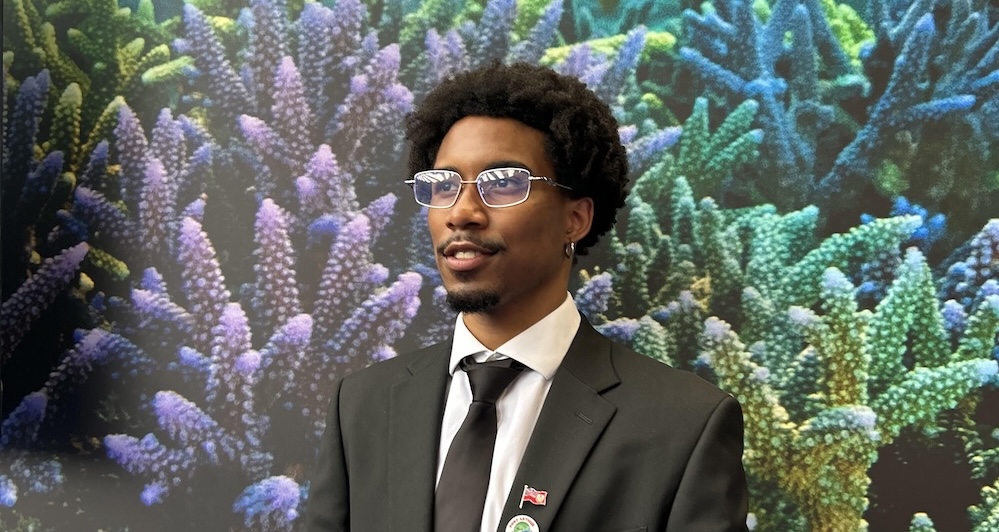
It wasn’t until after he left Bermuda that Jasiah Durham found the confidence to let people see his true self.
Growing up on the island, Mr Durham only received negative reactions from adults who found out he was queer – so he remained in the closet until he lived in Brazil.
His mission is to help create a more welcoming community in Bermuda in which all young people can find acceptance.
Mr Durham, 26, is the 2025 recipient of the OutBermuda Scholarship, which aims to empower members of the LGBTQ+ community. He is studying for a bachelor’s degree in politics and Hispanic studies at the University of London.
It’s been a long personal journey already, including a stint in Brazil as part of the Rotary Exchange Programme, when he was 17.
“I grew up in Bermuda as a closeted queer person. If there were any adults that ended up finding out that I was queer during my adolescence in Bermuda, the reaction wasn’t positive,” Mr Durham said.
“In Brazil one day, I broke down and told one of my host parents that I’m queer, I’m LGBTQ.
“It was such a brain-altering experience for her to say, ‘Oh, that’s fine. I figured that. I don’t care. I love you. It’s not that deep.’”
Love-hate relationship with Bermuda
At the time, Brazil was having a presidential election, which was won by Jair Bolsonaro, a vocal opponent of same-sex marriage.
Bermuda had recently undergone a referendum which, although it failed to meet the threshold for validity, showed widespread opposition to same-sex marriage.
But Mr Durham noticed key differences between the two countries.
Brazil, he said, hadn’t been hit by late-stage capitalism; its social institutions made it feel more community-based than Bermuda.
“It made me question a lot of things about the context of my existence in the world,” Mr Durham said.
“The context of me being Bermudian and what that means, an overseas colony, the culture of the people, why it feels slightly more homophobic and hostile there than it did in Brazil.
“Brazil was affirmation that I wanted to do something that would help a kid like me in my position to make life a little bit easier for them.”
After struggling with his IGCSEs while suffering with undiagnosed ADHD, he moved to Cardiff, Wales, and completed them at an adult education school. Mr Durham then worked for an insurance company in Halifax, Yorkshire. He staved off higher education because it felt financially unattainable and he didn’t want to apply for scholarships from Bermuda.
During this time, he retained a love-hate relationship with the island.
But he said: “I came to learn, eventually, that no matter where I went or wherever I was, I am from Bermuda.
“I have ties to this country, and I shouldn’t really be running away from it. I should be trying to make it a better place. It’s just how I felt.”
Mr Durham stepped up his activism by joining the Youth Summit of the UK Overseas Territories Association, writing policy ideas on LGBTQ+ rights and learning disability in education, and defending immigration.
“That same summer, I also attended the United Nations Overseas Conference on behalf of Bermuda, where we authored and recommended policy on things that we could do to bring about more security for our oceans, and respecting indigenous rights,” he said.
“With that, I started to feel like I was doing more for my country and I felt comfortable to apply for scholarships,” he said.
His entry into political circles improved his personal connection to Bermuda and ultimately led to the scholarship award from OutBermuda.
He is currently on a study-year in Colombia, South America, where he has been able to witness Black radicalism.
“I love Colombia. It’s a really cool place. I’m learning a lot. Here there’s a very strong, Afro community that I’ve gotten to like, learn and experience up close and personal, and they’re very community based.”
Seek your community
How could all this knowledge, experience, education and compassion eventually benefit Bermuda?
“I’m not quite sure, but I do know that I want to be involved. I got involved with the London office and I got to experiment with different branches of politics and government.
“Do I want to work in the London office and handle admin there? Do I want to work in neurodiversity? Would I want to work in education? Do I want to work for OutBermuda in the future? Do I want to work in the environmental industry and politics?”
One thing we can be sure about is that he will be advocating.
“We just have to keep on,” he said. “You have to advocate for what you want because no one’s going to give you something, and equally, sometimes you can’t just ask for something.
“If you want change, you have to make it happen and you have to take it.”
He believes late-stage capitalism promotes a very individualistic mindset, but that there is refuge in being able to choose your own community and helping one another.
“I think that that’s what helps me a lot,” he said.
“And just thinking about myself as like a young individual and the type of person that I needed back then as well.”
He’s not regretful about his childhood, but he would love to go back and speak to his anxious and fearful 16-year-old self.
“I would tell myself just to come as you are,” he said.
“I would say, you should focus on the people who will accept you for who you are. And as for everyone else, I guess, you just have to stay strong and stay firm in who you are, and eventually you become unshakable.
“And seek community. Seek people that you share things in common with. It may be hard at first, but as long as you move to the sound of your own drum, your tribe follows after you.”
