
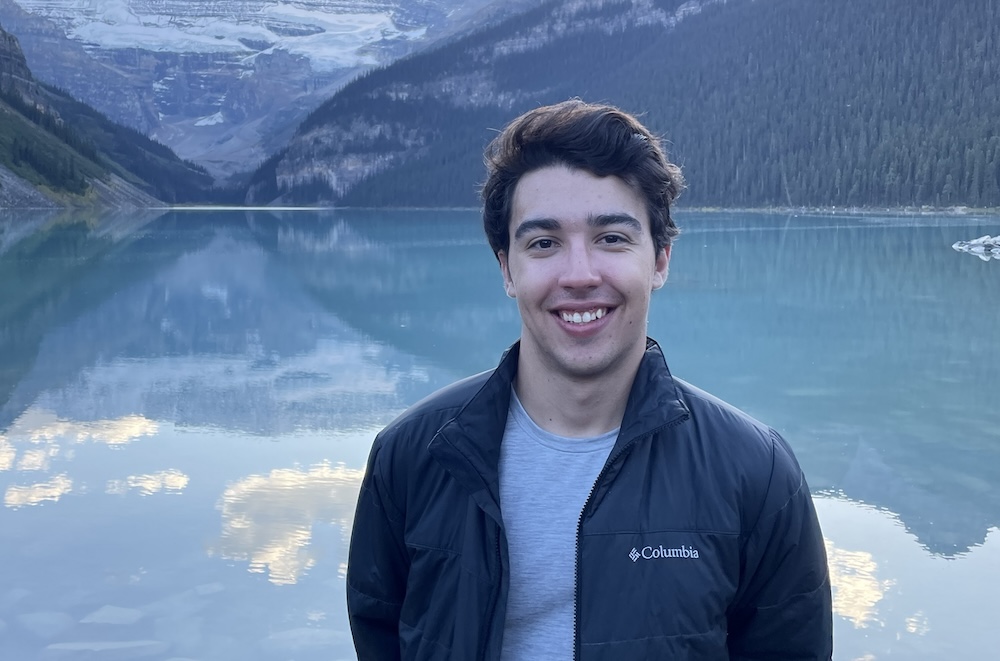
Noah Da Silva is a Rhodes Scholar, and he is not treating that achievement as a finish line. He is treating it as a tool.
He is preparing to begin doctoral study in earth sciences at the University of Oxford, where he will work with Dr Erin Saupe in paleobiology, exploring how deep time can inform modern conservation.
For Mr Da Silva, that global opportunity does not pull him away from Bermuda. It sharpens his focus on it.
“Warwick is, in my opinion, the greatest parish,” he said. “There’s so much life and nature around us.”
His family home was surrounded by forests and hills.
“My brother and I romped through them on weekends and in the summer.”
His connection to Bermuda is also cultural and deeply familial.
Boxing Day is when “the entire Da Silva clan descends upon one unfortunate person’s house for a big Portuguese family celebration”.
As a child, he “used to fear these days for cleaning required,” but now, “they’re one of my favourite times of the year.”
Some memories still make him grin.
On his birthday at Warwick Academy, he walked outside and found “three tiny hens on the front porch” and he “didn’t leave them for a few hours”.
After that, chickens became part of home life. “I loved taking care of them, collecting eggs and lying down with them in the sun below the palm trees,” he said.
Mr Da Silva’s interests have always stretched beyond the strictly scientific.
“One of my favourite things to do, and what informs my scientific career, is my love of storytelling,” he said. “I love performing and acting, especially in musicals, writing and building worlds out of nothing.”
It is not hard to see how that imagination translates into research. The ability to hold a story together is also the ability to see patterns, ask better questions, and keep going when the answers are not obvious.
Compelling journey of education
That mix of wonder and discipline carries through his education.
He studied at Warwick Academy from primary through secondary school, focusing on sciences and geography during IGCSE and IB, before four years at Dartmouth College shaped by field programmes in the American West for geology and in Costa Rica for ecological research.
His research life has been anything but small. Over the summer, Mr Da Silva spent a month in the Gobi Desert of Mongolia, drilling rock cores and excavating dinosaurs.
Much of his work now involves analysing those cores for their magnetic elements, building a record of rock formations and time.
Then, when his day’s tasks end, Bermuda comes back into view.
“I haven’t left my Bermudian research behind,” he said. “After I’ve finished my Mongolian tasks, I spend my nights in the Dartmouth soil laboratories, looking at Bermudian soil geochemistry and surveying snail species and populations. I’m in constant contact with Bermudian conservationists about my findings.”
Vital research
His Bermudian work centres on micro snails and the environmental conditions that allow them to survive. They are so small that most people never notice them, yet their decline can signal broader stress on habitats and the balance of ecosystems.
“My thesis demonstrated that soil type, rather than forest tree species, was the main reason why snails inhabited certain parts of the island,” he said.
“This disproves previous hypotheses that invasive trees led to the snails’ downfall. I think the true culprit is more complex.”
That conclusion is practical. It shifts conservation away from assumptions and toward targeted protection based on what is happening in Bermuda’s ground conditions. It also demonstrates one of the clearest ways Bermuda’s environment can benefit from Mr Da Silva’s skills and knowledge.
Bermuda needs conservation decisions grounded in Bermuda-based evidence. Mr Da Silva’s research adds that precision by identifying where threatened species persist, what conditions make those habitats viable, and how quickly invasive species are spreading. On an island with limited land and constant pressure on open space, that level of detail supports better prioritisation, stronger management plans, and faster responses when new information emerges.
His surveys underline the urgency.
“Our micro snails are in a dire situation,” he said.
“The majority of our endemic and native species are confined to small snail refuges across the island.”
He added: “Invasive micro snail species are colonising the island at speed.”
The evidence has already helped move Bermuda from uncertainty to action.
“This evidence helped demonstrate that endemic micro snails do in fact exist and in which environments they occur,” he explained, “leading the Department of Conservation to quickly move to lay down protections, as they couldn’t confirm this information beforehand.”
He is also involved in work focused on Vertigo micro snails.
“The conservation plan for Vertigo micro snails is just getting started!” he said. Their presence has been highlighted to the government and the Parks Planning Commission, and Mr Da Silva noted that a zipline slated for development in their Southlands refuge was grounded, with development halted in that area. “Soon, we’ll be securing Vertigo under the Protected Species Act,” he said.
After that, the work becomes long-term stewardship through a conservation management plan “to detail how their habitat will be preserved and sustained”.
He has also spoken about continuing Bermuda’s partnership with Chester Zoo and exploring breeding programs aimed at reintroducing these snails to other parts of the island.
Mr Da Silva is careful to frame the work as collective. “This project couldn’t have succeeded at all without the support of BZS, BAMZ and Dartmouth collaborators being willing to step in.”
As Oxford approaches, his ambition sounds less like escape and more like duty.
“When I was younger and only cared about dinosaurs, I figured I’d catch the first plane to Mongolia and stay far, far away from the island,” he said. “That’s not the case anymore.”
There is plenty in Noah Da Silva’s story to admire, Rhodes, Oxford, Mongolia. But the most inspiring part is the direction of his attention. It keeps returning to Bermuda, to the places where the stakes are real and the margins are small. He is building knowledge that can protect habitat, strengthen planning decisions, and give endangered species a better chance.
