
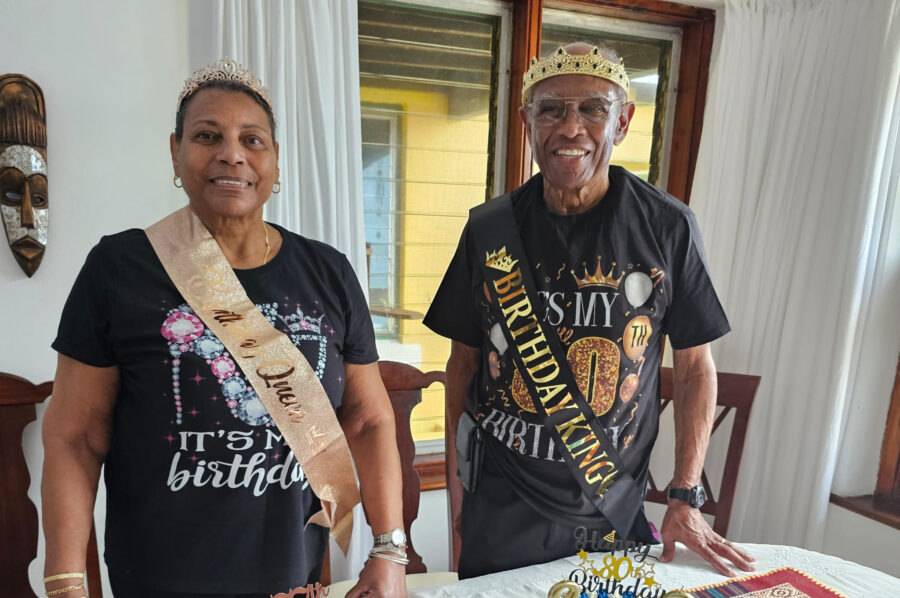
On March 11, 2025, Walter Carlington died peacefully at home, just shy of his 81st birthday.
For his sister Pamela and niece Sharon, his death marked the end of a long and painful journey through cancer – one that tested their resilience, their faith and the bonds of family.
Pamela remembers the first time she truly understood what her brother was facing.
“I knew my brother was sick,” she said, “but I didn’t realise how sick.”
Walter had quietly battled prostate cancer for years. He travelled for treatments, including surgery in Boston, often without fully disclosing the severity of his condition.
“He didn’t let anybody know. He had been traveling, but he just kept the ‘why’ to himself,” Pamela said.
When she finally accompanied Walter and his wife to Brigham and Women’s Hospital in Boston, the truth came into focus.
“His stomach was turned upside down,” she recalled. “They had to reposition it, put it back in place. He had so much going on that we didn’t even realise. And I was sick myself at the time.”
The weight of caregiving – for her brother, her sister-in-law, and her own health – became overwhelming. Pamela eventually called her daughter, Sharon: “I told her, I can’t cope anymore. I need your help. Get on the next plane. And she did.”
Carrying the burden together
When Sharon arrived, she found her mother stretched thin. Walter’s wife, she said, was in and out of denial, unable to fully confront her husband’s decline.
“So, mom had to manage it all,” Sharon remembered.
Pamela nodded. “I became the mother hen of the family. I kept check on my brother every day, called him morning and night. I looked after his wife, and I looked after myself. It was a lot. But I thank God for family, because without support, you’re in trouble.”
Holding on to normal life
Walter was determined to live as normally as possible. A faithful church member, he continued his role as the bishop’s chaplain for as long as he could.
“Every Sunday he came,” Pamela said. “Even when he wasn’t feeling well, he’d carry the cross, he’d serve. Until one Sunday I had to tell him, ‘Please, just go sit down. Don’t do anything.’ He was stumbling, and I knew he was too weak. But he didn’t want to stop.”
Walter also insisted on daily phone calls with his sister.
“We talked first thing in the morning, during the day, and last thing at night. Every day. That’s just what we did.”
The final Sunday
Pamela remembers the last time she saw Walter in church. He was visibly frail, but still present, still trying to serve. She told him again to sit and rest.
Later that evening, Walter was admitted to the hospital, but insisted he was fine. “He called me and said, ‘I’m home.’” Pamela recalled. “I said, ‘You’re where? Why are you home?’ He said, ‘I don’t feel bad, I’m okay.’ But he wasn’t okay. He just didn’t want us to worry.”
The following Monday, she spoke with him five times. Their last words were simple and familiar: “I said, love you, talk to you tomorrow.” Later that same night Pamela’s phone rang and the voice on the other line said ‘Walter has died.’
“I said ‘What?!’ I woke up the house.”
Sharon left work, and the two ladies immediately engaged in the business of supporting the entire family in this time of extreme distress.
A community’s goodbye
Walter’s funeral reflected the life he had lived – humble, loving, deeply rooted in community. “It was a Wednesday at 11 o’clock in the morning, but you would have thought it was a Sunday service,” Sharon said. “The church was full. Everyone loved him.”
Local businesses, including Pizza House, where Walter had worked repairing ovens for many years, contributed food and support. “They even donated his favourite cake,” Pamela says. “It meant so much to see how people cared.”
Pamela, who had organised Walter’s 80th birthday celebration just a year earlier, also took on the responsibility of arranging his funeral. “His wife said, ‘You know what he wants.’ And I did. I knew exactly.”
The role of faith
For both ladies, faith has been an anchor through grief.
“You can’t sit down and say, why did the Lord do this?” Pamela said. “It’s not your call. It’s the Lord’s call. My brother had 80 years of a good life – that’s not a bad innings.”
She added plaintively: “Cancer, and dealing with it, is personal. You can have caregivers, family, support – but in the end, the journey is yours. Everyone has to walk it differently.”
Living with loss
Now, some months after Walter passed, coping remains a daily challenge. Pamela is still working through the thank-you cards from the funeral. “They’re done, but I can’t bring myself to send them,” she confessed.
Sharon, who had given up much of her own life to be by her mother’s side during Walter’s illness, sees the journey as ongoing. “Every day, you deal with it,” she said. “You don’t get over it. You just keep going.”
Both find comfort in memories. They speak of Walter’s humility, his devotion to family, his presence in church. They speak of laughter in hotel rooms, of late-night phone calls, of the way he never wanted to burden others with his pain.
Pamela summed it up: “He was my brother, my closest friend. We respected each other, and we were very close. I miss him every day.”
A legacy of love
Walter’s story is not only about illness and loss, but also about love and connection.
“Everybody knew him. Everybody loved him,” Pamela reflected. “He was the complete opposite of me – humble, quiet. But he touched so many people.”
In the end, that legacy of love is what remains. The ladies continue to lean on one another, on their family, and on their faith.
“You deal with it every day,” Pamela repeated, her voice soft, resilient. “But I thank God for the time we had, and for family.”Bottom of Form
