
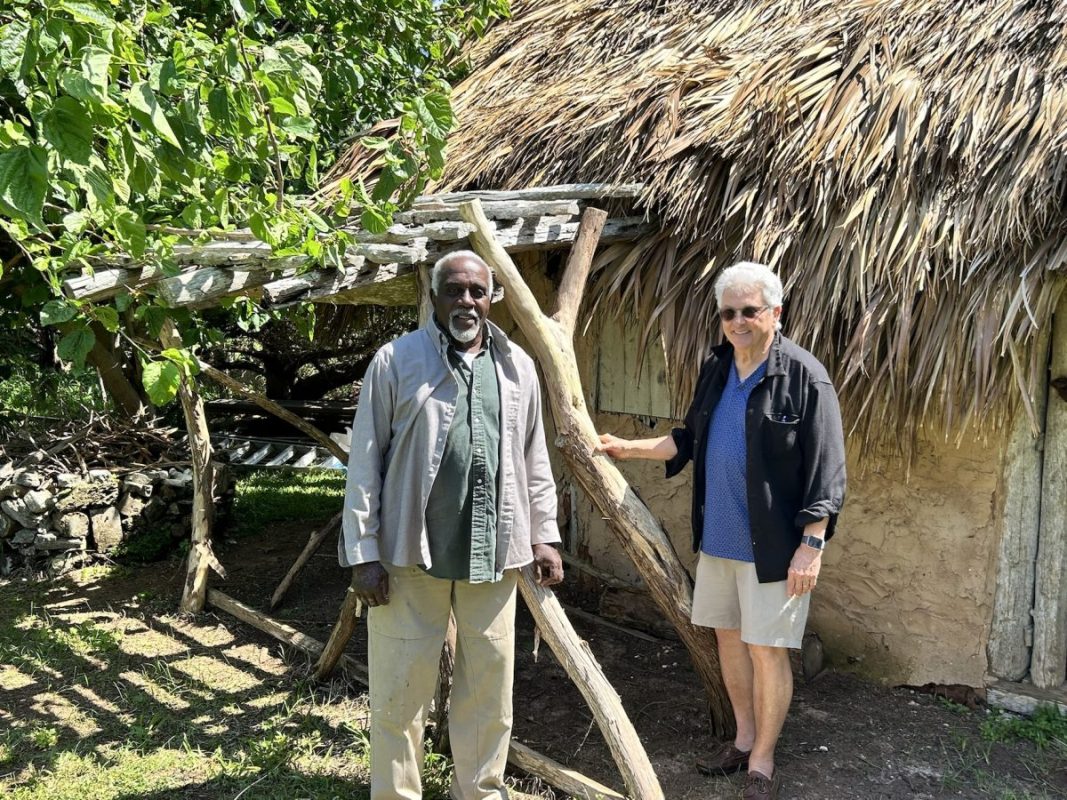
It’s bad enough when a hurricane strikes our modern homes with their robust roofs, stone walls and shutter-protected windows and doors.
But imagine what life was like for our island’s early settlers, who sheltered in dwellings built from mud and stud with palmetto-thatched roofs.
From the moment the Sea Venture grounded on the reef in 1609, survival in Bermuda depended on exploiting natural resources to construct dwellings capable of withstanding the dreadful and hideous storms that accompany life in a hurricane zone.
Early building techniques
Speculation still exists regarding the location and nature of the earliest dwellings constructed by the island’s early population. But we know that architectural techniques in Bermuda evolved through the combined influence of weather, necessity and lived experience.
“The evolution of how people did things depended very much on where they were situated,” said Larry Mills, director of the St David’s Historical Society.
“In Bermuda there are even instances where people growing up in Somerset learned different techniques from people living in St David’s.
“A lot of men worked on ships and travelled to foreign settlements, so it is also very likely that they adopted ideas and techniques they encountered during their travels.”
When the first settlers arrived in 1612, resources available included cedar, palmetto leaves and stone. According to the Department of Planning’s Traditional Building Guide, these materials “were unfamiliar, and each presented problems”.
It explained: “Cedar was dense and strong, but it only grew to a limited height and thickness. Palmetto leaves dried out and sometimes caught fire in the hot weather. Bermuda stone was far softer than any the settlers had previously known.”
Although we know little about how these first buildings were constructed, we do know that wood was the favoured material, and settlers bound for Bermuda were advised to bring “sawes, hammers, pearcers, pincers and nailes of all sortes so many as will serve to build a house with”.
Richard Spurling, chairman of the St David’s Historical Society, said: “The first settlers would have quickly realised that traditional European building styles were ill-suited to Bermuda’s climate.
“In those early years, they drew heavily on the experience of settlers in Jamestown, Virginia who had already learned to work with whatever materials were at hand.”
In Jamestown, homes were put up in haste using rough, bark-covered logs.
Mr Spurling said: “Because the timber was uneven, gaps formed between each course which were filled, a process known as chinking, to make the structures more weathertight.
“Here in Bermuda, they needed small, secure, weatherproof dwellings and they discovered that cedar, clay, palmetto and lime were readily available. After digging post holes, a wooden frame was most likely erected and then covered with cedar lathes which they plastered with a lime or clay mixture.”
Mr Mills said: “We also know that they would have understood gable roof design and thatching techniques as they existed in the UK at that time.
“These people were incredibly resourceful and quickly turned to palmettos, which were plentiful in the St George’s and St David’s areas, as a material for thatching.
“However, the thatch was most likely not nailed down but rather secured with handmade palmetto rope or thin strands of the frond which they used to tie the thatch to the underside of the rafters, none of which held fast under hurricane conditions.”
Early colonial records describe powerful storms in 1619, 1629, and 1669 that damaged homes, ships, crops and public buildings.
Over time, these hurricanes exposed the weakness of Bermuda’s early mud-and-stud houses, creating a desire for stronger storm-resistant dwellings. By the end of the century, settlers in St George’s were only being granted land on the condition that they build houses of stone.
The Settler’s Cabben
The Settler’s Cabben, designed by local architect Stephen West, is a heritage project at the Carter House Museum to mark the 400th anniversary of the arrival of the first settlers in St David’s in 1612.
Tools authentic to the period were sourced locally and in the United States, and every stage of construction proved a learning process.
Mr Spurling said: “There is quite a bit of speculation regarding exactly what these first dwellings looked like, so the design was based on a small woodcut image visible in the corner of John Smith’s 1624 map of Bermuda.
“The rough cedar frame is covered with a crude stucco composed of a Bermuda clay, sand, and twig mixture and is very similar to the ‘wattle and daub’ building techniques that the original settlers would have used.
“The only real difference is that we used nails to secure the thatch instead of simply tying it to the rafters.
“We initially hoped that the structure would last three years, but we have just rethatched the roof for the third time and the building is still in remarkably good condition.”
The Cabben itself has now lost its roof twice during major storms, in 2019 and again in 2025, further illustrating the vulnerability of early Bermudian dwellings.
Shark oil
Survival in Bermuda depended not only on dwellings to shelter in, but also on learning to read the signs of approaching weather.
Eager to devise a way to predict the arrival of hurricanes, early residents noticed that a clear glass jar containing liquid shark oil extracted from a young shark’s liver appeared to respond to changes in atmospheric conditions, turning cloudy or milky with the onset of deteriorating weather. By the early 1700s, it was common practice to hang a bottle outside one’s house.
Over time, the most seasoned observers began to discern subtle variations in the sediment, movement and opacity of the oil, giving rise to increasingly accurate predictions of approaching storms and wind direction.
In Bermuda, nature has always both destroyed and enabled. Passing storms continually tested building techniques resulting in an architectural style born not from theory, but from lived experience.
