
Bermuda could again face the wrath of Fay and Gonzalo, 12 years after hurricanes bearing those names hit the island just five days apart.
They are among the 21 storm names selected by the World Meteorological Organisation for this year’s Atlantic basin storm season.
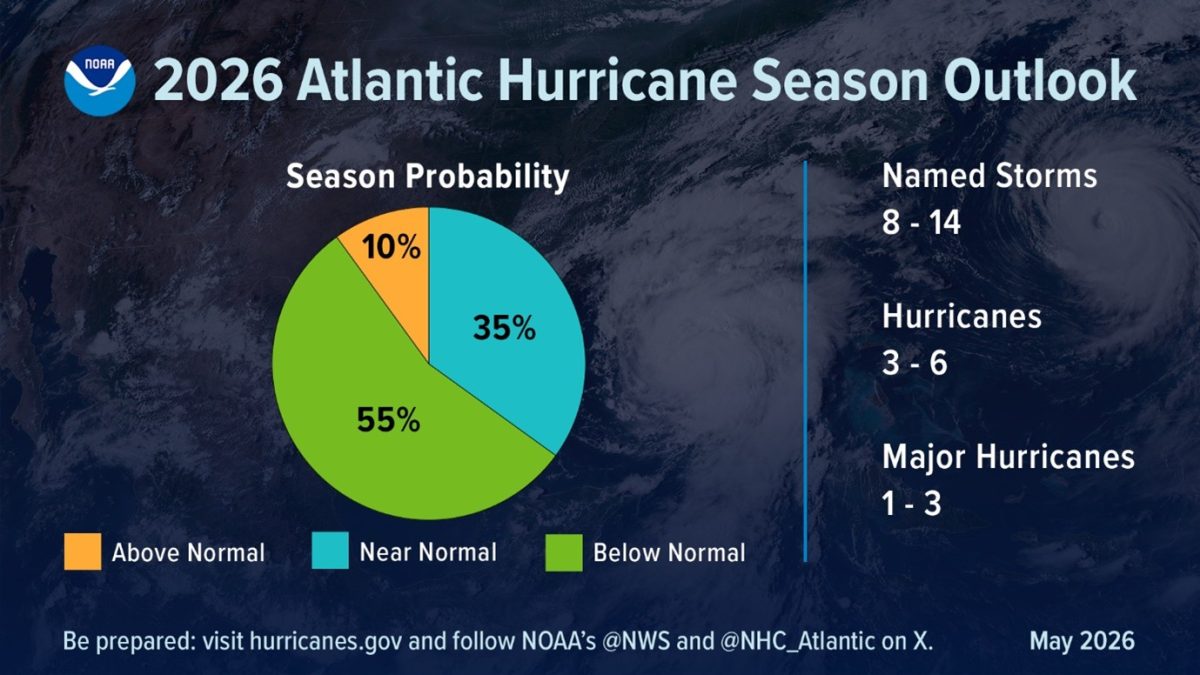
Forecasters with the US National Weather Service have predicted that the basin, which includes Bermuda, will experience a below-normal storm season.
The National Oceanographic and Atmospheric Administration, of which the NWS is a part, said the outlook predicts a 35 per cent chance of a near-normal season, a 10 per cent chance of an above-normal season, and a 55 per cent chance of a below-normal season.
The season runs from June 1 until November 30, although storms can form before or after that period.
The agency said it is forecasting a total of 8 to 14 named storms (winds of 39mph or higher). Of those, three to six are forecast to become hurricanes (winds of 74mph or higher), including one to three major hurricanes (Category 3, 4 or 5 with winds of 111mph or higher).
The NOAA said it has 70 per cent confidence in these ranges. An average season has 14 named storms with seven hurricanes, including three major hurricanes.
The organisation said the Atlantic season is expected to be below normal due to competing factors.
El Niño, which the US Geological Survey describes as “a warming of the ocean surface in the tropical Pacific Ocean that affects weather patterns worldwide”, is expected to develop and intensify during the hurricane season, while ocean temperatures in the Atlantic are expected to be slightly warmer than normal and trade winds are likely weaker than average.
El Niño conditions tend to support fewer tropical storms and hurricanes, while warmer ocean temperatures and low winds support a more active year.
“Although El Niño’s impact in the Atlantic Basin can often suppress hurricane development, there is still uncertainty in how each season will unfold,” said NOAA’s National Weather Service director Ken Graham.
“That is why it’s essential to review your hurricane preparedness plan now. It only takes one storm to make for a very bad season.”
The NOAA’s outlook is for overall seasonal activity based on large-scale weather and climate patterns. It does not indicate where or when any storms may affect land.
In addition to Fay and Gonzalo, the storm names for 2026 are Arthur, Bertha, Cristobal, Dolly, Edouard, Hanna, Isaias, Josephine, Kyle, Leah, Marco, Nana, Omar, Paulette, Rene, Sally, Teddy, Vicky and Wilfred.
Fay and Gonzalo thrashed Bermuda in October 2014.
While Fay was initially reported to be a tropical storm, many on the island were convinced that it was a hurricane – and they were proved right a week later when forecasters upgraded the storm to Category 1 hurricane status.
Just five days after Fay hit the island on October 12, Gonzalo barrelled toward Bermuda as a Category 4 but dropped to Category 3 just before landfall and then weakened to a strong Category 2 storm during its passage over the island. Both storms left thousands of people without power and caused widespread damage to properties and infrastructure.
Last year, 13 named storms formed in the Atlantic basin during the season. Five developed into hurricanes, four of which grew into major storms including three packing Category 5 strength (sustained winds of 157mph or higher).
Two storms left their mark on the island.
Hurricane Imelda, which arrived on October 2 as a Category 2, knocked out power to 18,000 Belco customers. Twenty-nine days later, Hurricane Melissa – also a Category 2 – caused nearly 20,000 homes to lose power.
The NOAA will update its outlook for the Atlantic hurricane season in early August.
