
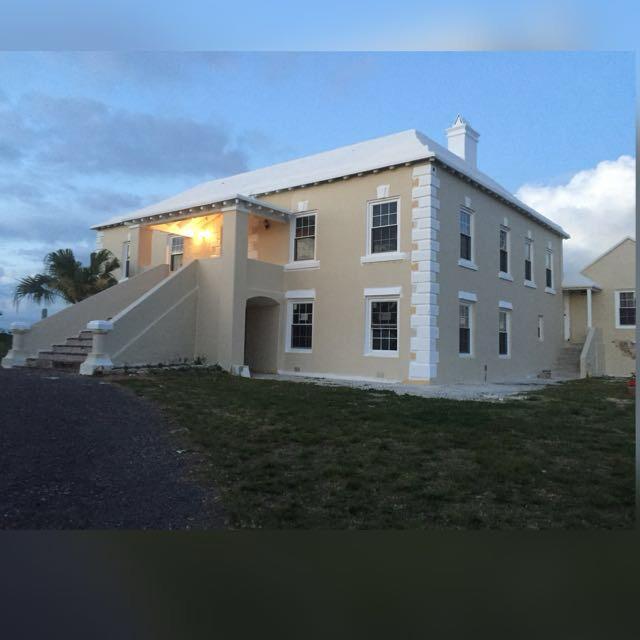
Throughout the length and breadth of the island stand monuments to how Bermudians lived and worked in times gone by.
These homes were built in the days before electric tools, cranes and concrete. They don’t have neat right angles or straight walls. They were built primarily using limestone and cedar. Their chimneys stand thick, strong and high above their white stepped roofs and their wooden shutters protect them from storms.
Whether large or small, built by rich or poor, all of these houses tell stories of our past and have histories we can learn from. To those who appreciate traditional houses, they have charm and character.
But what are they actually like to live in today? Can they be modernised without losing their character? And, are they worth preserving?
As researchers for the Bermuda National Trust, Margie Lloyd and Linda Abend have seen more historical homes than most and they care deeply about Bermuda’s unique architectural vernacular.
They agreed that, in order to appreciate the features of an old house however, it helps to have an interest in its history; and, while they can be expensive to maintain, all homes in Bermuda, old or new, require regular maintenance.
“They always say damp,” Ms Lloyd said. “But an awful lot of damp is caused by closing it all up, putting in air conditioning, never opening the windows.”
Another common problem is bubbling walls.
“The core of my house is old, it’s an old barn, and we have so much trouble with efflorescence. It’s where the wall starts to bubble and you get this white powder,” Ms Abend said.
“They say that older houses are costly to maintain but really, every house in Bermuda, it’s the weather, it’s the climate.”
If you live in an old home, when you renovate, it’s vital to respect the original features of the house, otherwise you risk ruining it.
Examples include a home where the owners removed the opening arms staircase from the front of the house, and another where they added a concrete plate to raise the roof.
“In an old house, the windows are up by the eaves,” Ms Abend said. “It doesn’t look old anymore. It could have been built yesterday. It’s amazing how just lifting up the roof, one layer, what a difference that makes.”
Other traditional features that stand out for them are chimneys, butteries, domed tanks, wooden verandahs and fanlights over the front doors, which allow light into what would otherwise have been dark rooms.
Mount Wyndham
Someone else with a passionate appreciation for traditional Bermudian architecture is Kristal Bartram, who owns grade two listed Mount Wyndham in Hamilton Parish.
The home was built during the 1780s and enjoys views over the entire East End of the island. Most famously, the house was leased in 1812 to the British Admiralty, to be used during the war between Britain and the United States.
When Ms Bartram bought the property ten years ago, it was derelict, and she has been painstakingly restoring it to its former glory ever since.
“I love traditional Bermuda architecture,” she said. “The house had been on and off the market for quite a while before I was able to purchase it and so I had seen it, and the view was spectacular. I loved everything about the house.”
While Ms Bartram was excited at the prospect of bringing this stately property back to life, the most common question people asked her was: “Are you crazy?”
Did she ever think she was? “Sometimes,” she smiled.
Her initial priority was to make the house liveable, so the plumbing, electrics, windows and doors were the first to be fixed.
After that, she set about carefully restoring and modernising the house. Now, it is a spectacular four-bedroom, 3½-bathroom multi-generational home, which has retained all of its historical charm and much of the original craftsmanship.
The former outside laundry room is now a one-bedroom cottage, which she rents out as a bed-and-breakfast, and the former outhouse is used as garden tool storage. This structure had a wooden window opening, which was four pieces of wood that she replaced.
“I’m trying to keep the integrity of the house,” she said. “Everything is the way it is for a reason.”
This ethos underpinned every aspect of Mount Wyndham’s restoration. It was, therefore, important to chose designers, contractors and craftsmen with experience working on historic homes. These included L&S Design’s Shelley Ray, Byland Construction and mason, Dean Saunders.
A number of Bermuda stone features on the property were refurbished by Mr Saunders, using lime, which is the building material that would have been used when the house was first built.
Elsewhere, the roof does not have latex, which allows it to breath. Ms Bartram has kept all the Bermuda cedar in the roof and on the ceiling, and when restoring the internal structures, she made sure that the contracting team were mindful of the original handcrafted dovetail joints, collar ties and beams.
“Someone who isn’t familiar with that type of construction can really do damage to the house,” she warned.
Such was her determination to honour the history of the house, that she not only kept an upside down cedar banister, wrongly installed by a previous owner, but she had another upside down one installed to match it. “I like this story,” she laughed.
She said she has no damp issues because she didn’t install air conditioning.
“It’s high on a hill, two storeys, so the crosswinds are amazing,” she said. The house also has high ceilings.
She admitted that the upkeep is hard work. The cedar doors need to be sanded and revarnished every three years and she gets her roof redone annually.
For her, it’s worth it.
“I think this is the only opportunity for a bridge between what that life was like and what our life is like now,” she said. “We’ll never see that again.”
