
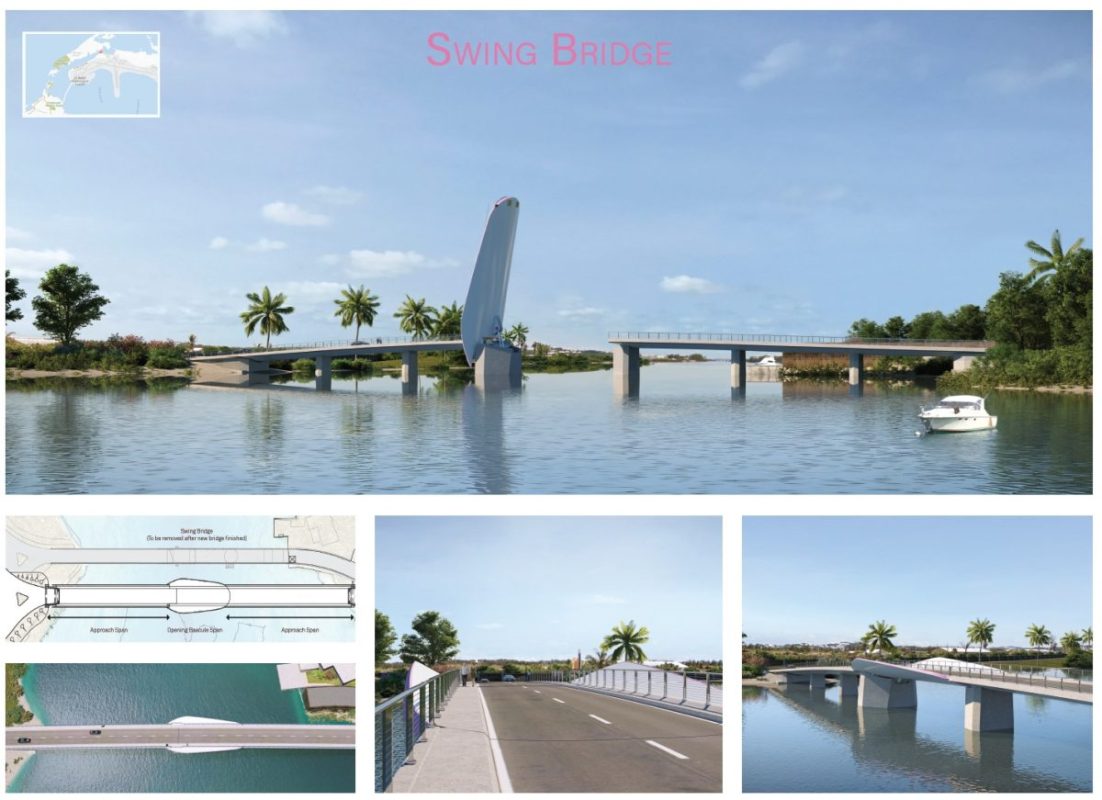
Easy on the eye but robust enough to last for at least 75 years – the new Swing Bridge will provide a spectacular yet solid facelift for Bermuda’s East End.
Construction work is finally set to get underway to replace the ageing bridge that connects St George’s Island with St David’s Island over Ferry Reach, nearly a decade after the plan was first announced.
The project, led by award-winning British designers Ramboll, is one of the biggest upgrades for Bermuda’s infrastructure in living memory.
Architect drawings have offered a preview to a sleek and futuristic design. Eadon Consulting, which is supporting Ramboll, say the bridge has been designed with a distinctive curved deck structure which will create a “striking first impression” for visitors arriving at LF Wade International Airport.
But to stand the test of time in Bermuda, it will also need to withstand hurricanes, humidity and salty air.
A spokeswoman for the Ministry of Public Works and Environment said: “In terms of aesthetics, the Ministry acknowledges that design is subjective, but notes that the design team has won numerous awards for bridge projects, and the new structure is expected to represent a significant improvement on the existing bridge.
“Reliability and durability have been central to the design process, with the bridge engineered for a working life of 75 years.
“While some components will require replacement over time, with appropriate maintenance, the bridge is expected to meet and potentially exceed its design lifespan, providing resilient infrastructure for decades to come.”
Ageing structure
The existing bridge’s substructures date back to 1864, when the main forms of transport were horse and carriage and foot traffic.
A new bridge, called Swing Bridge was put in place in 1964, as part of efforts to improve access to St George’s.
Since then, Bermuda’s salt water and warm weather have taken their toll on its steel structure.
Rehabilitation work took place in 2002 and 2007, when the bridge was strengthened with additional girders, and cross beams were strengthened with steel plating.
But it has since been declared beyond economic repair, with then public works minister, Lieutenant-Colonel David Burch, stating in 2017 that it had outlived its expected life span of 50 years.
Plans for a new bridge were unveiled in 2018, with Ramboll as the lead designer, supported by Knight Architects and Eadon, but were delayed due to factors including the Covid-19 pandemic and encroachment on National Trust Property nearby.
The Development Applications Board granted approval in 2025.
While Ramboll, Knight and Eadon have developed the bridge design, the Ministry said a contracting firm will be selected through an open tender process to carry out construction.
“The Ministry expects strong interest from overseas builders and anticipates opportunities for local contractors to participate in the project,” she said.
The next visible phase of work is expected to be site preparation.
It’s estimated the bridge will take three years to build, but there’s good news for East End residents regarding the impact on traffic.
The spokeswoman confirmed the new bridge will be constructed alongside the existing Swing Bridge, just to the east, allowing the current bridge to remain in operation during construction.
“While the Ministry does not anticipate major disruption, some traffic adjustments will be required,” she said.
“These arrangements will be fully communicated in advance, supported by diagrams and public information.”
She added: “As the project progresses, the timeline will be refined, and the Ministry intends to provide regular updates to the public.”
New technology
Jaché Adams, the Minister of Public Works and Environment, said last year that the bill to replace the Swing Bridge would run between $50 million and $60 million and that $3.8 million would be spent on “preparatory work” before construction started.
The Swing Bridge was originally designed to lift, to allow ships to pass through. In recent times, it is so corroded it has become stuck in a fixed position, which limits shipping access to the harbour.
The new bridge will have a hydraulically operated lift, creating a 72ft wide space for vessels to pass through. When closed, it will allow for a clearance of 13½ft for boats at high tide – an increase of 3½ft on the original bridge.
The roundabout on the southern side of the Swing Bridge will be realigned as part of the project.
Planning documents show construction work will take place from a barge, using prefabricated sections.
New technologies and materials such as ultra-high performance concrete and high-performance steel – mean modern-day bridges are guaranteed better durability, strength, resilience and a longer life, even in Bermuda’s climate.
Bridges can also be embedded with sensors that provide continuous feedback on structural conditions, allowing engineers to identify and address problems earlier.
The British design team also won the contract to nearby replace Longbird Bridge, which has also undergone emergency repairs after deteriorating in recent years.
Longbird Bridge, built in the 1950s, is the twin carriageway steel bridge at the east end of the Causeway, which connects the island with the airport. It is expected that Longbird Bridge will be replaced at about the same time as Swing Bridge, but detailed plans had not been shared at press time.
