
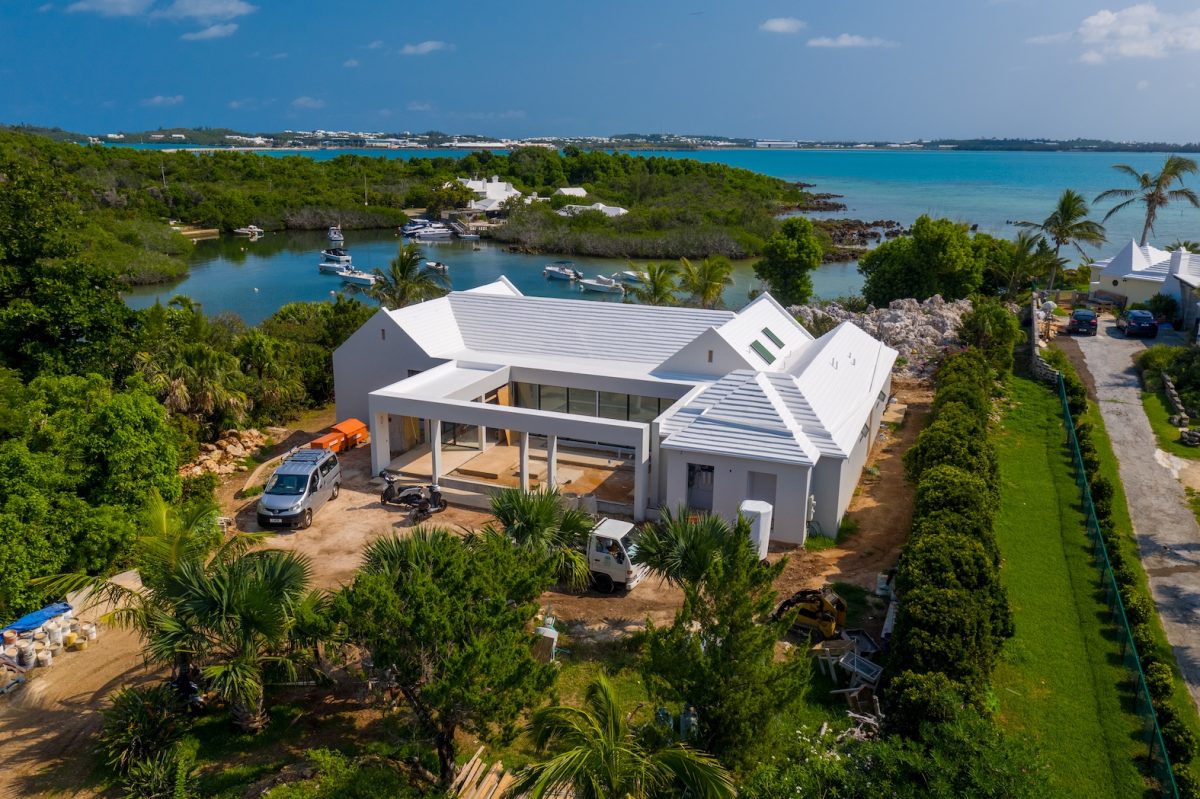
White stepped and pitched roofs, shutters, pastel colours, tall chimneys and welcoming arm staircases are just some of the many architectural and design features that make Bermuda’s homes unique.
Many of these evolved out of necessity: the need to collect rainwater, reflect the sun, protect against hurricanes and access a house built into a slope.
Over the past ten years however, more modern architectural features have started to become the norm, made possible by more advanced technology and available materials, such as large windows with hurricane-proof glass, narrow frames and no shutters.
Many of these homes were designed to have clean lines and interesting shapes, defined by a mixture of roof styles, often without eaves.
On the inside, gone are the lower ceilings, narrow openings and small rooms. Instead, new build or renovated homes tend be designed to reflect more modern ways of living, with open plan indoor outdoor living spaces, basements, home offices and gyms.
In spite of these modern approaches to traditional design, the aesthetic still remains distinctly Bermudian.
At the forefront of many of the island’s more contemporary interpretations of traditional home designs are architects, Jonathan Castro and Ché Caines of E Se Studios.
 They explained what is influencing the new designs, which modern features are most popular, and the aspects of traditional Bermudian vernacular that should never change.
“Architecture is very much in touch and in tune with society in Bermuda,” Mr Castro said. “In the same way that they would say construction is an indicator of how well a country is doing.
“If there’s construction, then it’s prosperous. With architecture, it is an evolution of what the industry is and what it means.”
Evolution
Bermuda’s architecture has always been influenced by where we are from.
“If you were talking to us 50 years ago, the large majority of people building homes would have been local Bermudians or those with a lot of history and roots in Bermuda,” Mr Castro said.
“With the advent of the Permanent Resident’s Certificate and statuses, you have a lot of people who are not actually born here in Bermuda, but want to put roots down in Bermuda. They are the ones who are setting up the stage for this new architecture.
“In that event, the modernisation of Bermuda is a catalyst that’s coming from those who are taking all the bits and pieces of development from everywhere else that they see and wanting to apply it here in a thoughtful way.”
One of the most common conversations with clients is about door and window heights. Traditionally, they tended to be around seven feet. Now, the demand is for eight feet or higher so that homeowners can have as much natural light and connection with the outside as possible.
“Technology with windows and doors is advancing, so now we can have larger doors, larger windows, bifolding, sliding, pocketing, whatever you wish depends on your pocket book,” Mr Caines said.
Thinner aluminium windows and doors are also becoming increasingly popular, as are interior skylights, to get natural light into what would otherwise be a dark space.
It’s not just windows and doors that are changing.
“Spatial hierarchy, materiality and natural lighting are primary factors that dictate that transition from traditional vernacular and a more modernised approach,” he continued.
“The way in which living spaces are laid out, so you see most modern houses, they have higher ceilings, for example. They have larger opening spans because now we have the materials to do so, like steel beams that weren’t around when we were building out of stone. You can do large spans to have a large, open plan living space.”
To keep these large, open plan areas clutter-free, and for extra storage, basements have also become popular, which older Bermudian homes didn’t tend to have.
Ms Castro said the basement can also house “non-essential back of house services”.
Being practical
Bermuda’s homes have always been built with the island’s climate in mind, and this hasn’t changed, but how it looks has.
Large, covered overhangs and hurricane screens allow homeowners to use their outside spaces whatever the weather.
“People want that open air living that you can get in places like California, but they want the ability to close it up when it’s also 95 degrees outside, and 89 per cent humidity,” he said.
The architects emphasised, however, that in order to modernise traditional architectural features, you first need to understand their original purpose: eaves, for example, which the modern barn-style aesthetic doesn’t have.
“The reason you have an eave line is to drip the water off the edge off your roof, so it doesn’t hit your building,” Mr Castro said.
“In response to that, you create an eave detail that captures as much water as possible so the only drops you have coming over are not that much.”
Another option is the overhang which is “ever so slightly angled so that’s shooting the water off”.
He explained: “So, any water that is coming is being propelled because the angle is a little bit steeper at that point.
“Once you know the reason behind something, you can change things and make it different or make it unique, which is why you’re seeing the newer takes on Bermuda roofs, why parapet flat roofs are becoming a thing now.”
In recent designs, E Se Studios has introduced these different roof styles, creating interest and a modern aesthetic through a mixture of pitched and flat roofs.
What always ties the design back to Bermuda however, is the white steps, and in Mr Caines’ opinion, this, along with the pastel colours of our homes, should never change.
“The danger with everything progressing and technology evolving and styles evolving is losing our identity, and who we are and how we build is a primary force in architecture,” he said.
“There’s different ways in which we can build, but still retain the look and feel of our architecture. Those are two key characteristics that make Bermuda, Bermuda.”
