
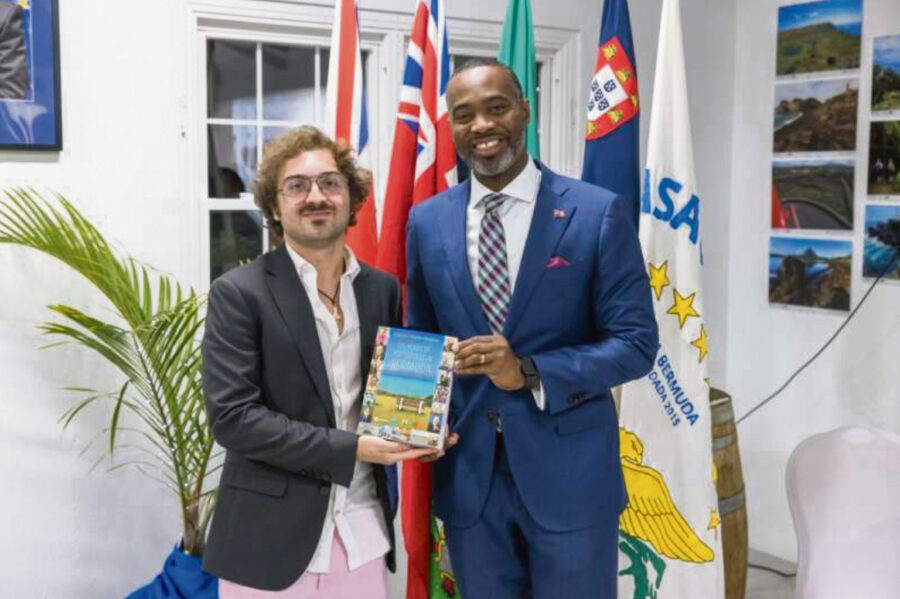
Like many Azoreans, Eduardo Pereira Medeiros had always heard about Bermuda as a “land of opportunity”.
From a young age, even though he had never visited the island, he knew the names of Portuguese Bermudians such as Johnny Pereira and Eddy DeMello.
He also has a family connection of his own: his late uncle, Antonio Andre, emigrated to Bermuda in the late 1990s to work in construction. His father later followed and still lives here.
Mr Medeiros first visited the island in 2021 and prepared by reading The Story of Bermuda and her People by WS Zuill and Patricia Mudd’s Portuguese Bermudians: Early History and Reference Guide.
Rumours based on fact
What really intrigued him though, were the rumours he had heard.
He explained: “People used to have these rumours how it was back in the day, ‘My grandfather came here on a steamship.’ ‘We were discriminated.’ ‘Women were not allowed.’”
He struggled to find detailed answers from easily available sources and so began his book, 175 Years of Portuguese in Bermuda, published in November 2024.
Wellknown events in the history of Portuguese ties to Bermuda are well documented – the 1543 Portuguese Rock inscription believed to be by adventurer, Theodore Hernando Camelo; the arrival of the first Portuguese settlers from Madeira on 6 November 1849 aboard the ship Golden Rule; the crucial role Portuguese immigrants played in revitalising Bermuda’s agricultural sector; and the different waves of arrivals throughout the 1900s, introducing the island to Portuguese culture.
But what about the rumours? How many of those turned out to be true?
“Almost all,” he answered. “The fact that Portuguese were considered a third race. The fact that women were not allowed to go with their husbands. How they were discriminated in some places.
“One rumour I found was true was a specific school just for Portuguese kids, Gilbert Institute. That’s a taboo that existed and I realised that it was true and very sad.”
Individuals who made a mark
Powerful quotes in the book include those from former United Bermuda Party politician, Tony Correia, who said: “My parents went through a lot. You couldn’t go to certain places, you couldn’t go to certain restaurants, you had to use the back door.”
Through painstaking research and extensive interviews, Mr Medeiros has documented what life was like for Portuguese immigrants and their descendants. Much is also made of their success, in spite of what many had to endure, and their lasting impact on Bermuda today.
He singles out D&J Construction founders, Johnny Pereira and Dennis Fagundo as “some of the most iconic symbols of success in Bermuda”, alongside Eddy DeMello who had such a “huge impact not in the Azorean community only, but in Bermudian culture and community as well”.
Mr DeMello’s father had worked on a farm for nine years, but returned to the Azores because Bermuda’s immigration policy didn’t allow families to emigrate to Bermuda. The family were able to emigrate together in 1949 and Mr DeMello’s lasting music legacy remains.
At 22, he took out a loan to buy the Music Box, where he was working, and expanded the business. In the 1960s he ventured into music production, working with, among others, the Talbot Brothers and Hubert Smith, who recorded the song, Bermuda is a Another World. He even brought Ray Charles and Stevie Wonder to Bermuda.
Another Azorean Bermudian who arrived as a child in 1949, was Luis Bernado. He went on to become a celebrated architect and president of the Vasco Da Gama Club, particularly well known for his award-winning floats at the Club’s Heritage Day.
Others of Azorean descent who he met or learnt about, and who left their mark on Mr Medeiros, include teacher, Portuguese rights activist and former chairman of the Portuguese Bermudian Organisation, Anna Faria; former attorney-general and minister of legal affairs, Trevor Moniz; and Fernance Perry, who arrived in 1926 aged three and famously turned the small Piggly Wiggly shop he owned into a supermarket empire, which is now part of the MarketPlace.
“When people think about Portuguese Azoreans in Bermuda, they think about landscaping, agriculture, but the fact is that our people were everywhere,” Mr Medeiros said.
Overcoming injustice
Initially, the Portuguese impact was predominantly economic, but this changed significantly in the 1960s. While some men had been able to emigrate to Bermuda with their families, it had been a difficult process, made impossible for some when the government formalised a policy that meant Azorean wives could not join their husbands in Bermuda.
Catholic priest and vice-consul, Fr Filipe Macedo, was instrumental in changing this. A native of Northern Portugal, Fr Macedo arrived in Bermuda in 1958 and fought for improved working conditions as well as the reunification of Azorean families.
“In 1968, that’s when it happened, the great opening of all these families going to Bermuda,” Mr Medeiros said.
“Then, of course in the 70s, you have all the culture and then in 1982, you have the agreement that finally ended discrimination against Portuguese.”
Lasting impact
It was the arrival of families that brought many Portuguese traditions to the island.
“If they had no family in Bermuda, they didn’t have much time to be in celebrations and having a good time. They were just working,” he explained.
“It was this coming of families to Bermuda that allowed Portuguese culture to spread and grow. That’s why you have Santo Cristo coming in the 70s. That’s why you have folklore groups coming in the 70s. Because in 1968, all of these families were allowed to come.”
While Mr Madeiros had been sad to learn about the discrimination many Portuguese immigrants had suffered, he ultimately felt pride.
“When I was interviewing people sharing their stories and sharing their tears, the work they had to go through, all of the sacrifices. Even to go through that suffering made me proud of my culture and my people. What Azoreans achieved in Bermuda makes me feel very proud.”
