
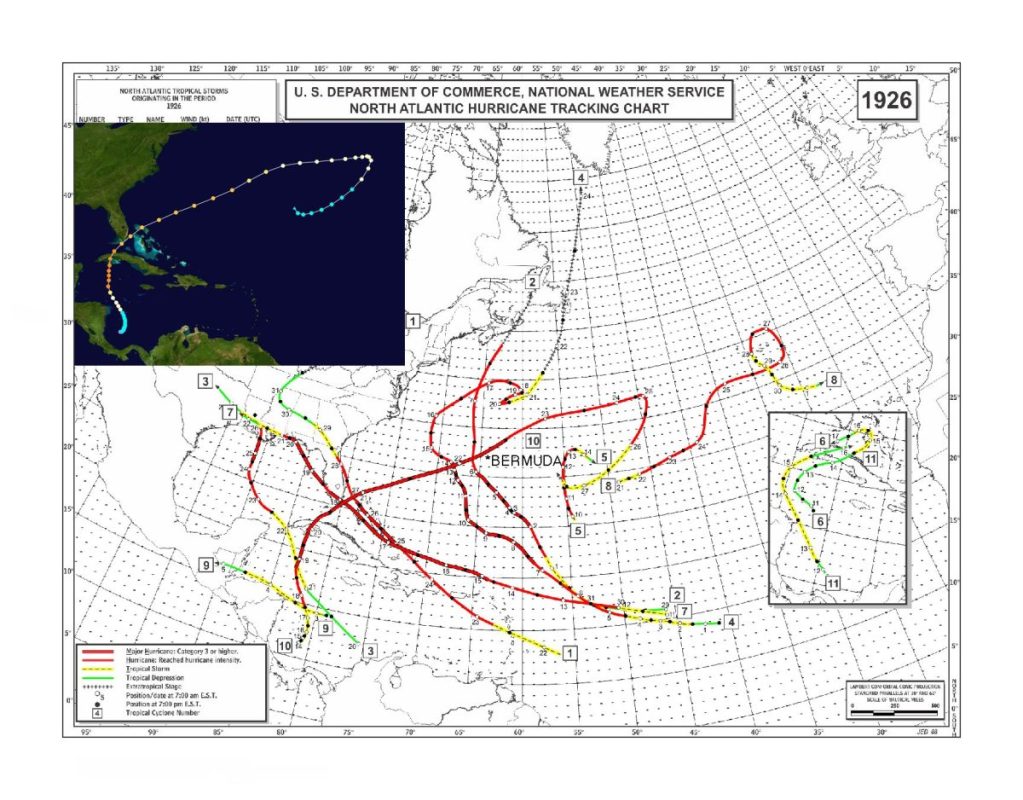
One hundred years ago this year, on October 22, 1926, tragedy struck Bermuda when the Havana-Bermuda hurricane claimed the lives of more than 100 people.
The storm barrelled the island with with wind speeds of 138mph, damaging 40 per cent of our buildings, destroying two homes and sinking two ships.
The hurricane was so called because it formed south of Cuba, in the Caribbean sea.
HMS Valerian
The greatest loss came through the sinking of HMS Valerian, a British naval ship returning to Bermuda after providing hurricane relief to the Bahamas.
“The fact that she was returning from an errand of mercy to the Bahamas – visited twice this year by hurricanes – adds an ironical note to the affair,” reported The Royal Gazette and Colonist Daily on October 25, 1926.
Even in those days, forecasters knew this storm was approaching Bermuda, but it moved quicker than anticipated, overtaking the Valerian, and sinking her 18 miles south of the island at 1pm on that fateful day.
At one point, she had been in sight of Gibbs Hill but when Commander William Usher couldn’t see any marker buoys, he thought it would be safer to ride out the storm offshore and decided to head back out to sea.
The exact number of lives lost is difficult to determine. The official report into the wreck states that 86 crew members perished, but an order of service from the memorial service held at Bermuda Cathedral on October 31, 1926, stated: “A Memorial Service for the 89 Officers and Men of HMS Valerian, who lost their lives in the hurricane of October 22nd.”
What is known, however is that this loss affected Bermuda greatly.
“A profound gloom was spread over the island and the utmost sympathy is felt for the relatives and friends of the victims,” reported the newspaper.
“HMS Valerian was a popular ship on the Station, and officers and men had made many friends,” the article continued.
In a feat of amazing strength, 19 crew members, including Commander Usher, survived by holding onto a raft for 21 hours before being rescued by HMS Cape Town.
SS Eastway
Six hours after the Valerian went down, disaster struck again when the cargo ship, SS Eastway, went down 100 to 120 miles north of Bermuda. A total of 22 men drowned that evening and 12 managed to survive by scrambling into a lifeboat. According to the Board of Trade inquiry into the incident, they were rescued by the Luciline at noon the following day and brought to St George’s.
Amid this tragedy however, was also great bravery as commended by John Hayes, MP for Liverpool Edge Hill, speaking in the UK Parliament on December 15, 1926.
“The engineers and firemen refused to overload the remaining lifeboat and went down with the ship rather than endanger the lives of their comrades,” he said.
Damage on land
The only significant injuries on land were those done to buildings, trees and crops.
Reporting in the October 2026 issue of Monthly Weather Review, W.H. Potter noted: “Apart from two houses, unoccupied, destroyed in Hamilton, the damage, while rather large in the aggregate, was for the most part small individually.
“No one was killed and one slightly injured, and there was no damage to speak of to the small boats in the harbour. The telephone was hit hard, but the electric lights were on in Hamilton by 7pm the 22nd and here across the harbour by the next evening.”
The majority of the damage, he observed, happened during the second half of the storm, after the eye had passed. Casualties included The Colonial Opera House on Victoria Street where, reported The Royal Gazette and Colonist Daily, “portions of the stone work were carried over the surrounding houses until they went through an actual bombardment”. A large piece went through the roof of a Mr A. Vallis and smashed a wardrobe and another landed between the dining room and kitchen within six inches of a Mrs C.W. Pantry.
A child in Cook’s Hill, Somerset, had a narrow escape when the house belonging to Mr Albert Gilbert had its gable end blown in, roof carried away, and ceiling partially blown in.
“In one room, a child was resting in a perambulator when it was noticed that bits of ceiling began to fall.
“The child was removed to another room by Mrs Gilbert just in the nick of time, when the whole ceiling of the room from which the child had been removed came down.”
There were more close calls and acts of bravery in Dockyard when HMS Calcutta was swept away from the jetty. To prevent further damage, two officers “jumped into the water with life-buoys, and swam downwind with lines to the Calcutta, which enabled her to haul other hawsers on board”.
A hawser is a heavy rope used for mooring ships.
Her crew, along with the crew of another ship, HMS Wistaria then did “their utmost to help the Calcutta through her trouble, which was a nine hour struggle against the elements”.
Other news reports of the storm include damaged roofs and windows, destroyed crops, particularly banana trees, and downed cedar trees.
As tragic as the loss of life was, Bermuda fared better than Cuba, where news from October 21, 1926 reported 650 people killed, 2,100 injured, 10 towns and villages completely destroyed, and 6,500 people left homeless.
Even by modern day standards, especially when we consider what some Caribbean nations have been through in recent years following the wrath of hurricanes such as Irma, Maria and Melissa, the fact that only 40 per cent of Bermuda’s buildings were damaged by a Category 4 hurricane in an age before modern storm tracking, is a sign of strength that prevails to this day.
