
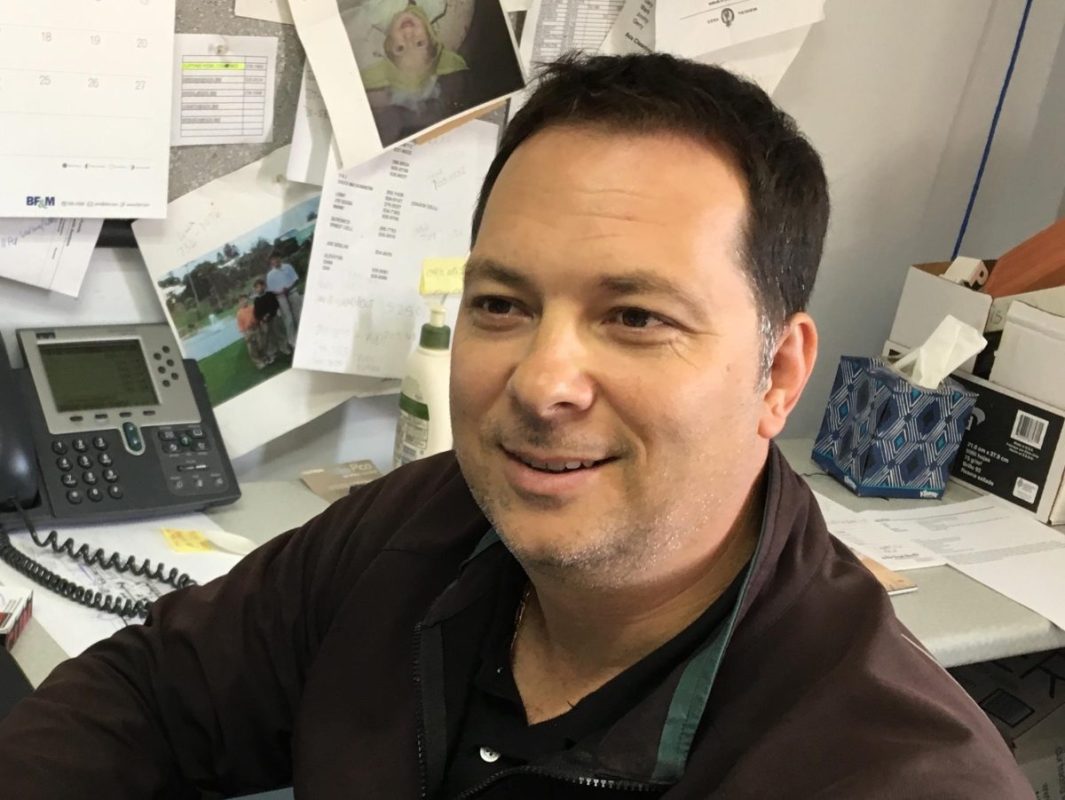
Zach Moniz is an old hand when it comes to hurricanes.
Many of us depend on Mr Moniz and his staff at the island’s two Lindo’s Family Foods outlets to help us get through the worst storms, particularly when high winds knock out power.
Having weathered many a hurricane, the owner-operator of Lindo’s stores in Warwick and Devonshire is well-placed to observe the different approaches we take when a hurricane strike is imminent.
“There are two types of shoppers for a hurricane,” he said.
“There are those who are preparing for the worst, and there are those who are preparing for a party.
“People come in to buy canned goods, but they also buy water, flashlights, batteries. They might buy some buckets. That’s the prepared person.
“Everybody does storm food prep for a hurricane. For example, the chip aisle gets hammered. The prepared people and the party animals prepare for the day in almost the same way.”
However, Mr Moniz said: “It’s what’s going to happen afterwards that they prepare for differently. The people that have been through a few storms and know what it’s like to live without electricity, they’re getting stuff that’s going to be useful after the storm.
“Those are the people that you should be like. Get water, get batteries, and don’t buy too much stuff that you’re going to have to keep cold in the fridge.”
One tip is to freeze big bottles of water and turn them into blocks of ice.
“They can be used in your cooler if you lose power, and they are going to keep everything in that cooler cold for a long time.”
All hands on deck
While we’re doing our last-minute shopping, Mr Moniz and 90 staff in Warwick and just over 100 employees in Devonshire have their own pre-storm roles.
“We are being run off our feet. We’re preparing pallets of water to put on the shop floor. We’re calling our suppliers. Generally, we have batteries in hand, but it’s usually not enough. We’ve got an extra stand that we push out on the shop floor that’s full of batteries and flashlights.
“We’re also trying to find ways to manage what’s going on in the store as well as our own homes because that gets neglected when you’re in the retail space.”
Mr Moniz counts on the support of his family.
“My wife Kristina handles what’s going to happen at home. I’m like, ‘You’ve got the outdoor furniture, right’? And she’s like, ‘Yes, don’t worry about it, just go to work’.
“In and around the store, we’re making sure that whatever objects we have lying around outside, like trash cans and whatever else that could turn into a flying object are all put away, or we’re preparing to put those away once we’re able to close.
“We usually have water on hand but if we have to go to one of our other warehouses to pick up more, we do that. It’s easy to take a pallet and shove it on the shop floor.
“We’ve got Rubis calling us saying, ‘What’s in your generator? We’re going to come and top it up’. They’ll do that before the storm. And then immediately following the storm, as soon as the roads are passable, they’re calling us again.
“Do you have power? Are you on generator? If we’re on generator, they’ll swing by every three days to make sure we’re taken care of.”
The generator is a diesel-powered, 500-kilowatt beast designed to kick into gear within 30 seconds of Lindo’s losing power.
“The generator powers the whole place and is a lifesaver. You could probably run an estate of ten houses on it.
“I just need to make sure I’ve got enough battery life in the computer rooms to hold power long enough until the generator kicks in and takes over.
“I’ll be home and I’ll get security alerts saying that the power has dropped at Devonshire or Warwick, and I’ll dial in from home to make sure that I have access through those 30 seconds, so that I know that the generator has kicked in.”
Making it work
The generator is serviced monthly – but things, as they say, happen.
“The batteries have a ‘date replace’ sign on them because that’s going to be your downfall. If your batteries are dead, you can’t start the generator.
“That happened once, but not in a hurricane. We just lost power out of the blue. So, we drove a truck right up to the door near to the generator, connected the jumper cables, started up the truck and ‘boom’, we got the generator going. You’ve got to make it work, right?”
Mr Moniz said the 13,000-square-foot store in Warwick, and the 18,000-square-foot outlet in Devonshire, re-open as soon as possible after a hurricane.
“We know that some people need ice because they’ve got medications that they need to keep cold. There are others, like the Royal Bermuda Regiment and first responders, whose needs we need to be able to meet.
“We never tell staff that they need to come in right away. I tell them ‘if you can make it, make it. If you can’t, don’t’.
“We open with whatever staff we have on that day and do the best we can with what we’ve got. Customers recognise what’s going on and are generally pretty good about it.”
He recalled one occasion when all the produce team lived together in the same house, which got hit by a tornado.
“I mean, their clothes were hanging in the trees, so it was bad,” he said. “You don’t expect them to be at work. You make do with what you’ve got.”
On average, Lindo’s keeps a six-week supply of non-perishable goods in stock.
If any of the cargo ships – Bermuda Islander, Oleander, Somers Isle – that serve the island is delayed due to a hurricane, that can result in a shortage of immediately perishable foods like produce or chicken.
Mr Moniz said: “If it’s going to be too dangerous, the ships will hold where they are, wait for the hurricane to pass and then they’ll come in behind the storm.
“With all three boats, usually whenever they’re sailing, we’ve got something on them.”
