
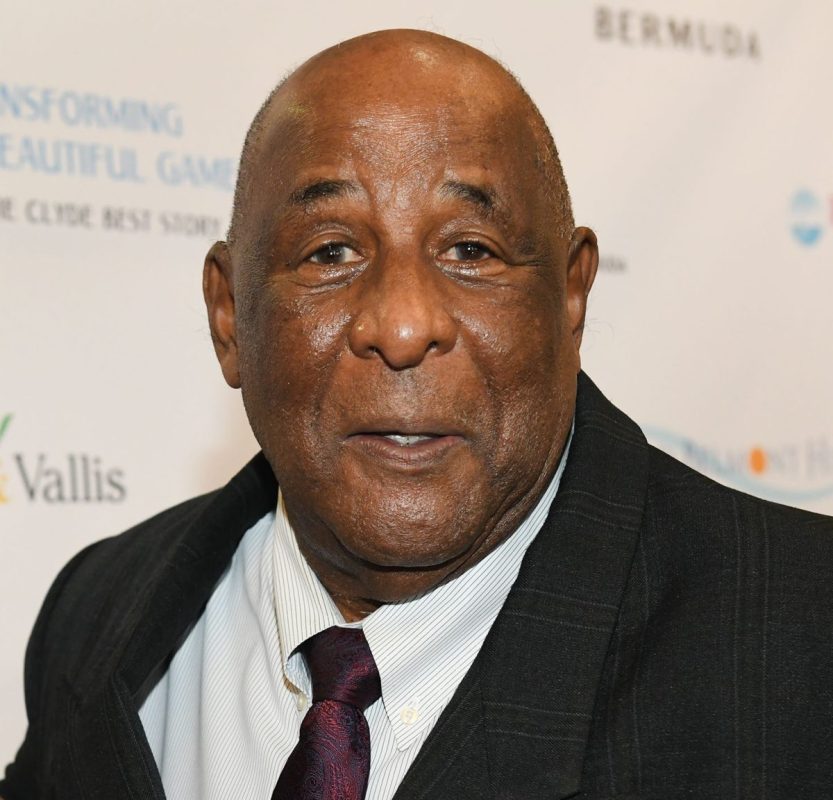
Clyde Best has an extraordinary ability to find a fond memory within a harrowing personal ordeal.
There’s no anger or bitterness in the wonderful documentary about the Bermudian icon’s trailblazing life – just a quiet sense of satisfaction that he helped create a better world for the people that came next.
That isn’t to say Best pulls any punches in Dan Egan’s Transforming the Beautiful Game ― The Clyde Best Story.
But when he recounts the horrendous incidents that punctuated his dazzling footballing career, he does so with matter-of-fact calmness; rather than waste energy condemning the villains, he reflects on his love for the people that supported him.
These were not trivial incidents.
There was the time he received a letter from someone threatening to throw acid in his face at an upcoming match, which prompted his teammates to form a human shield around him as he entered the pitch.
“They were in my corner,” Best recalls in the film. “I loved them guys like brothers because they made sure I was comfortable and was able to do my job.”
Or the moment he got tired of the monkey noises from Everton supporters and decided to show them what he could do by scoring a spectacular goal.
“After that, all the monkey chants stopped. They started to applaud.”
He gently chuckles at the memory.
Mental strength
Best has shared his stories many times before, and his messaging is always consistent. Don’t give up. Believe in your talent. Seek the positives.
The Clyde Best Story highlights how this attitude underpinned Best’s career, from playing as a boy against men for Somerset Trojans, to his audacious trip to London for a trial at West Ham United as a 17-year-old in 1968, which resulted in him becoming a pioneering Black player in English football, and later in the Dutch top flight and North American Super League.
The way he handled rampant racism inspired some of the greatest names in British football, including his colleagues at West Ham and a whole generation of Black footballers.
Geoff Hurst, a teammate at West Ham who won the World Cup for England, says: “I can’t recall him saying much about it, or really getting disillusioned by it. I’m sure he must’ve been inside, but he never showed that.”
Best’s sister Marie suggests Hurst was right.
“He used to call constantly my mom and my dad,” she says. “He wanted to come home because he was being treated badly.
“If it was left to my mom, he would have come home. But because of my dad … he encouraged him to stay.”
The story of Best’s father is one of the most poignant segments of the documentary. Marie tells how Best Sr, originally from Barbados, was one of the few survivors after a merchant marine ship was torpedoed off Bermuda.
“Coming from that kind of environment, he knew how to stick to whatever he set out to do.”
Best evidently inherited the doggedness. Most of all, he wanted to abide by his father’s instruction to pave the way for future Black players. He knew that if he ‘mouthed off’ about his mistreatment he would not last long, and others would be less likely to get their chance.
His insistence on showing the other cheek wasn’t just for the benefit of Clyde Best. It was for the sake of all Black footballers. Legends of the English game including Ian Wright, John Barnes, Viv Anderson and Les Ferdinand share their gratitude in the documentary.
Wright, who wore the Number 8 shirt in his Arsenal days as a tribute to Best, declares: “My career probably doesn’t happen if Clyde Best doesn’t happen.”
The road ahead
The film also charts the evolution of racism in Britain. There’s a haunting clip of 1970s TV character Alf Garnett hurling vile abuse at Best at West Ham’s Upton Park, which serves as a reminder of how deeply racism was ingrained within British popular culture at that time. Over the next couple of decades, Black players had bananas thrown at them on the pitch, and bullets and razor blades sent to them in the post.
Racism has still not gone away today: British supporters might not make monkey chants anymore, but booing can often be heard when Black players take the knee to make a public stand against racism.
Ferdinand points to statistics showing that nearly half of today’s Premier League footballers are Black – but the number of them who proceed with management careers is comparatively tiny. Barnes makes a compelling case about the need for greater discussion about the roots of racism in society.
Yet when Best was recently interviewed about the lack of coaching opportunities for Blacks, his response was typically upbeat: Black coaches should never give up; those that get a chance must show what they can do; things will get better.
Best’s footballing excellence, incredible mental strength and compulsion to go where nobody else had gone before enabled him to build a magnificent legacy that put Bermuda on the map and transformed Britain’s national sport.
“My plan was to do big things, and I done it,” he concludes at the end of the film.
“I would hope that a lot of the kids of colour that saw me playing were able to say, ‘Hey, I’m going to do what I see that guy doing,’”
Wright, Barnes, Ferdinand, Anderson, Shaun Goater, Nahki Wells and thousands more can vouch for that.
The footballing world will forever be grateful.
SEPARATE PANEL – please use high up the page if possible
‘I did it for Bermuda’
Transforming the Beautiful Game ― The Clyde Best Story has won widespread international acclaim since its release in April.
But speaking with Local Legacies at the Bermuda premiere at City Hall, Best explained it’s not just about him.
“Everything I have ever done in my career, it wasn’t for me – it was for Bermuda,” he told us.
“The most important thing about this film is our young people. I want them to understand it doesn’t matter what size your country is. What matters is whether you are willing to do your best to be a success.
“Coming from a place the size of Bermuda, as a 17-year-old, and finding my way in the English game – that’s the best legacy to have.
“I’m glad I had the peace of mind to do it.”
