
In the 75 years since the Royal Navy left, Bermuda’s Dockyard has undergone a seismic shift.
What was hailed by the late James A. Ziral, writing in The Bermudian, as “the largest military defence utilisation of money, manpower and materials in nineteenth century Bermuda,” has become a cultural hub, cruise ship destination and one of Bermuda’s most visited tourist attractions.
Walking around Dockyard today, visitors can marvel at the imposing Commissioner’s House, former Cooperage, Victualling Yard and Keep, which now house restaurants, shops, Dolphin Quest and the National Museum of Bermuda.
Behind these huge stone monuments however, lie stories not just of military might, but also of human strength, misery and skill.
What did it take, for example, to construct such fortifications and undertake the work required of a Royal Naval Dockyard throughout the turbulent 1800s and early 1900s? Who were the people that physically transformed what had been wooden wharves and storehouses into one of the best examples of imperial naval architecture and engineering in the world?
Early labourers
“The adequate supply of labour was one of the greatest threats to Bermuda’s imperial development,” wrote Anna McKay, then a collaborative doctoral student at the National Maritime Museum, Greenwich, and the University of Leicester, in a 2018 article for the NMM.
The Royal Navy had acquired Ireland Island in 1809, after the American Revolution meant the loss of naval bases along the United States’ eastern seaboard. Initially, contracted labourers were brought over from England, and in 1810, wrote Ms McKay, “enslaved Black men from Bermuda appeared in the Dockyard account books.”
As locals, she added, “they provided expert knowledge and experience but did not have any choice in the matter, nor did they receive wages of their own.”
French and American prisoners of war also worked at the Dockyard, as did enslaved refugees who came to Bermuda from America.
In 1823, she continued, “the construction of the Dockyard was greatly enhanced… by the arrival of convicts.”
They were housed in unsanitary prison hulks, moored off the Dockyard and St. George’s, and worked there until 1863.
“If they behaved well, convicts could be pardoned or take a ‘ticket-of-leave’ in the Australian colonies. They were not allowed to settle on the island as residents objected to this.”
For those working at the Dockyard during this period, conditions were harsh. In addition to suffering from exposure to the elements and injury from the back-breaking work, many suffered damaged eyesight caused by light reflecting off the white stone, and, explained Ms McKay, yellow fever epidemics “frequently wiped out scores of convicts and military personnel.”
Dockyard apprentices
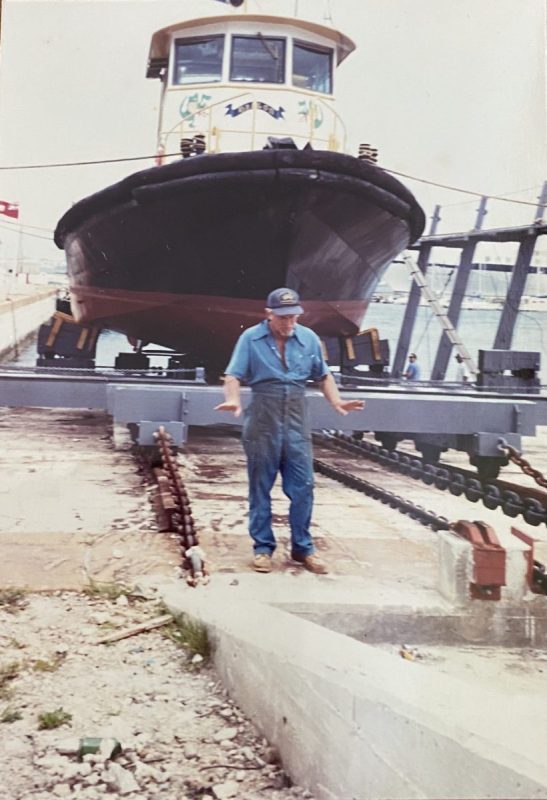
While the horrendous circumstances of those early workers make for grim reading, there was a more positive labour legacy that emerged from the Dockyard. The Dockyard apprenticeship programme trained generations of young men as master tradesmen, including carpenters, plumbers, electricians, welders, engine fitters and shipwrights.
In her July 19th 2023 Royal Gazette article, ‘The Dockyard Apprentices’, historian, Cecille Snaith-Simmons, wrote: “In 1844, a racially integrated school opened in the Dockyard to provide general and technical education for the children of Admiralty employees.”
One hundred years later, the British Admiralty opened the school to Bermudians in an apprenticeship programme. In 1950, when the Dockyard closure was announced, the final group of 49 apprentices were sent to Portsmouth, England, to complete their education.
This provided an employment lifeline at a time when the Dockyard’s closure meant many Bermudians lost their jobs and businesses.
The ‘Bermuda Family Scrapbook’ section of the NMB website includes a number of personal recollections from those whose family members had been Dockyard Apprentices.
Angela Fraser-Pitcher shared the story of her father, Harcourt “Jack” Fraser, who went to Portsmouth in 1950 to complete his training as a plumber.
“He returned to Bermuda in 1954 and was employed by Burrows Junius H Plumbing Ltd until he joined the HM prisons Service in 1971 as a prison officer having responsibility for plumbing.”
Another submission highlights marine engineer, Edward William “Buster” Gibbons, who also went to Portsmouth in 1950, met his wife there, and moved back to Bermuda in October 1963 where he worked in the Dockyard.
“I remember as a child going to Dockyard with my dad,” recalled his daughter, Beverley McLean. “You had to check in with a security guard at the entrance. A lot of the buildings, which are now shops, were workshops for the Dockyard.”
She continued: “He was rarely idle and built many household items. He even built himself a couple of boats!”
The future of Dockyard
While history has always celebrated military success, the personal histories of those who built and worked in the Dockyard are the focus of its future.
“Dockyard plays an essential role in Bermuda’s collective memory and civic life,” said Elena Strong, NMB executive director.
“Heritage research shows that museums are particularly important for small island communities in providing space to engage with contested and difficult histories. For Bermuda, this includes confronting legacies of enslavement, colonialism and inequality.”
Looking to the future, she said, “requires moving beyond static preservation towards inclusive, emotionally resonant, and research-led interpretation.”
This means “shifting interpretation from monuments to lived experience. Its story must be told not only as one of military engineering, but as a complex Atlantic World site shaped by enslavement, colonial labour, migration, resistance, and global exchange.”
At present, she said, much of the Dockyard’s interpretation is concentrated within the museum, however she would like this to change.
The future, she said, lies in “developing layered, flexible forms of interpretation, using discreet signage, digital tools, art, and storytelling that respect Dockyard’s operational nature and historic environment while helping visitors understand the history embedded in the landscape”.
The museum also envisions Casemates as a centre for Atlantic World Studies, which, Ms Strong said, “recognises that Bermuda’s heritage is both a local responsibility and a global contribution.”
She hopes that those whose ancestors built and worked in the Dockyard will become “active partners in shaping how its history is told”.
