
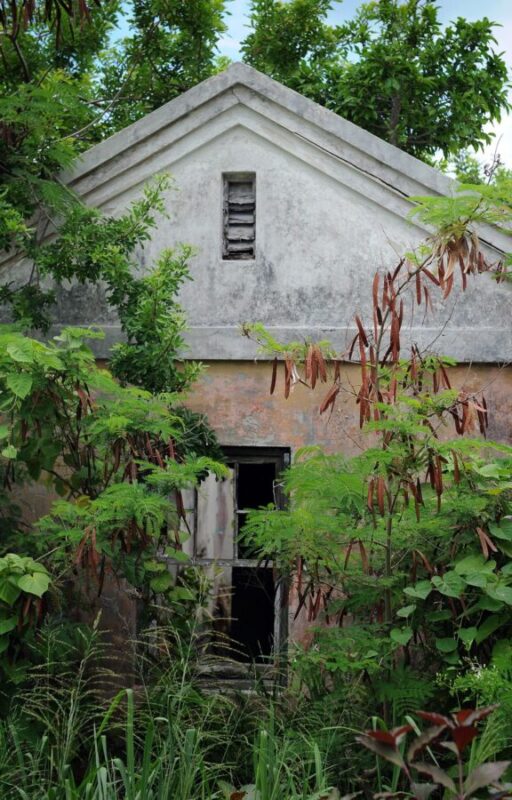
Bermudians want to see action on the island’s hundreds of uninhabitable structures to help address the housing crisis, responses in a survey commissioned by The Royal Gazette indicate.
Nearly three-quarters of respondents (72 per cent) said they would support a government-backed lending programme, in partnership with local banks, designed to encourage owners to make repairs to derelict homes. Only 9 per cent would oppose such a scheme, while 19 per cent were unsure.
And nearly half of people (46 per cent) would welcome the Government being empowered to seize long-term derelict homes for redevelopment into affordable housing, by means of compulsory acquisition orders.
Other respondents were split between opposing the measure (28 per cent) and being unsure about it (26 per cent).
The survey of 401 residents was conducted for The Royal Gazette by Global Research. With Bermuda going through a housing crisis and with more than 1,100 people homeless, the results reflect strong support for converting a blight on the landscape into badly needed homes.
The Department of Planning, in its 2023 Housing Land Audit, recognised 333 units as “uninhabitable”. These are properties categorised by the Department of Land Valuation as having an annual rental value of $0.
Pembroke was the area with most uninhabitable structures (43), followed by Sandys and the City of Hamilton (each had 31), Warwick (25) and the Town of St George (22).
The report stressed this data probably failed to capture all uninhabitable properties, since the onus was on owners to apply for “uninhabitable” classification, which sometimes they did not do.
Issues that render a property unfit for living in include a collapsing roof or floor, or a combination of smaller defects that “go beyond normal repairs”.
The report explains: “Anecdotal evidence suggests that many of these properties are locked in family disputes, lack of kin readily available to inherit property, or insufficient finances are available to refurbish property so that it can return to the property market.”
Crystal Caesar, the Minister for the Cabinet Office, stated in December 2024 that the Department of Planning was working on an updated Housing Land Audit, which was not available at the time of writing.
Some of the uninhabitable buildings are are government properties. The Bermuda Housing Corporation is in the process of a four-year project to redevelop 77 derelict units to add to its available housing stock by 2027.
In April this year, The Royal Gazette reported that the Government was considering penalties and incentives to stimulate development of vacant properties.
A government spokesman was quoted as saying: “Vacant buildings are often empty because their owners lack the financial means to carry out necessary renovations. Simply increasing the tax burden could make revitalisation even more challenging. Instead, the Government believes a holistic and creative approach is required, one that carefully balances penalties and incentives in a way that is fair, equitable and effective.”
A government-backed lending programme to help owners of dilapidated buildings to fund renovations proved popular in the survey. Partnering with a local bank in such a way enabled the Government to launch a mortgage guarantee scheme in October 2022, in which qualifying first-time borrowers received rates as low as 5 per cent and down payments of 10 per cent for mortgages with Bermuda Commercial Bank.
As for development of newbuild affordable housing, that is only likely to happen if the Government provides financial incentives to developers, agreed nearly half (48 per cent) of respondents to the survey. Just under one in five (18 per cent) disagreed, while one third (34 per cent) were unsure.
