
Floors are one of the hardest working features of any house and choosing the right flooring for your renovation or new-build home is, therefore, a big decision.
Once installed, flooring is difficult and expensive to replace, so it needs to be able to last the test of time, as well as be durable and able to withstand Bermuda’s climate.
Flooring experts Randy Stafford and Gordon Benson of the Stafford Group, sat down with RG Home to explain the different products available, the considerations homeowners should factor into their flooring decisions and what they would choose if money was no object.
If money’s not a matter, Mr Stafford recommended natural stone or wood.
“Natural stone has its own mother nature look, which can’t be duplicated,” he said.
He warned, however, that both these materials come at a substantial maintenance cost as well as a monetary one.
Natural stone is porous and needs to be regularly resealed, and Bermuda’s damp, humid climate doesn’t go well with solid wood. If you are importing it, you need to wait several weeks before installing it to allow the wood to acclimatise.
“Real wood is a hard product to look after,” Mr Benson said. “You go away, you don’t put the air-conditioning on, and then the place is like a greenhouse and the wood swells, and it’s all ridged and cupped.”
LVT
Is it possible to get the wood or natural stone look, without the high cost? Yes! Mr Stafford and Mr Benson recommended luxury vinyl tile (LVT), which is available in plank or tile form. LVT isn’t new, but its quality has improved substantially in recent years.
“The reproduction has come a long way,” Mr Benson said. “It used to look like plastic. You could tell what it was. But now, quite often, you would be hard pushed to tell the difference between a real engineered wood floor and a vinyl floor.”
Mr Stafford added: “One of the manufacturing groups that we represent, they have a piece of real wood, and a piece of LVT connected and it’s like, choose which is the real [wood]. It’s very hard to see, unless you touch it.”
Mr Stafford works with the LVT brand Karndean, whose LVT flooring options include a variety of stone and wood designs.
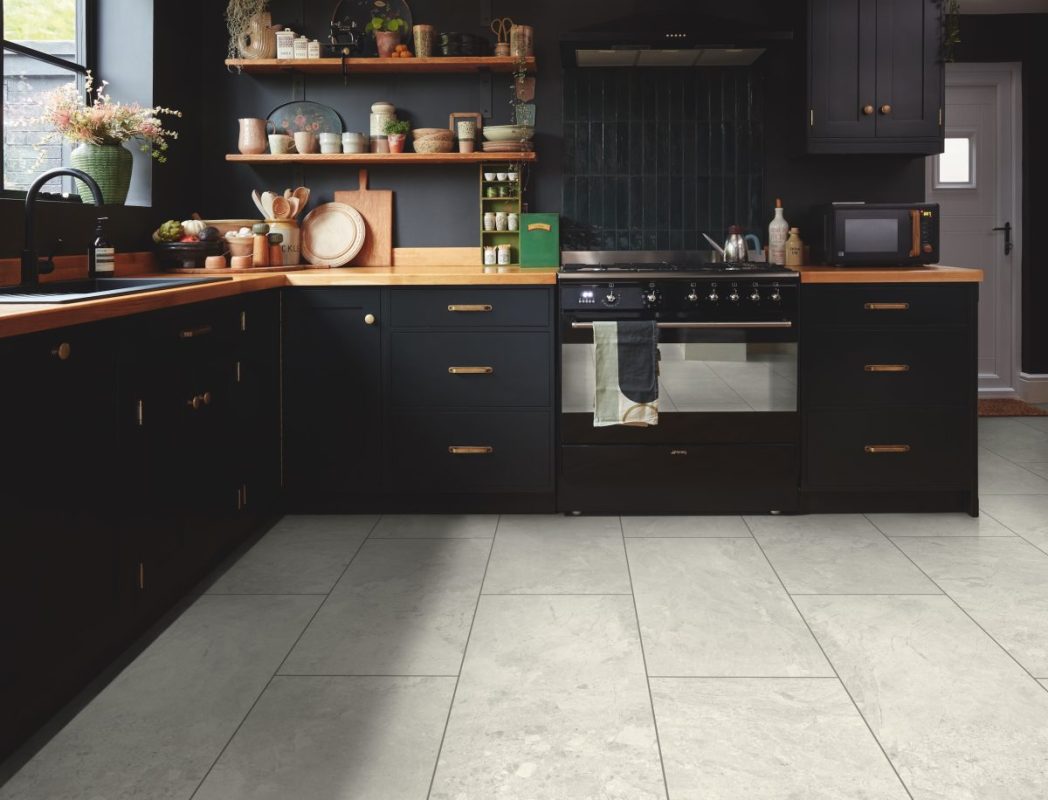
“The stones, in particular, are a really good substitute for tile,” said Mr Benson.
LVT is also durable and can withstand not just moisture, but also the “massive differential of humidity between the winter and the summer”, which makes it a popular choice for Bermuda’s homes.
It is also more cost-effective to install than a lot of other flooring options, and more comfortable to stand on than a porcelain tile.
“There’s an inherent comfort in the construction of the material,” said Mr Stafford, who explained that this is an important consideration for harder working rooms, especially the kitchen:
“You don’t stand in your living room, unless you let a lot of people in the house. You sit on the couch. You go to your bedroom, you lie on your bed. So, your kitchen is where you stand. That’s where the LVT has a great advantage.”
Another benefit is its versatility. LVT comes in a multitude of different colours and styles.
Engineered wood and tile
Two other products that also stand up well to Bermuda’s climate are tile and engineered wood.
Where solid wood is made from a single piece of timber, engineered wood has a real hardwood top layer and then a manufactured, softwood or multi-ply core. If someone is committed to having a wood floor, but is concerned about the maintenance, or they need to install new flooring into an old home, and want the floors to be in keeping with the historical nature of the house, “engineered would be the best product,” said Mr Stafford.
Tile also remains popular, particularly for bathrooms, and where an internal floor leads to an outside space such as a veranda or pool deck. Some of the manufacturers they work with have a matching indoor and outdoor floor tile, but the outdoor version has a grip to prevent you from slipping:
“We just finished doing a pool house and a pool surround and that was a tile that went from the pool house and then out to the pool deck,” shared Mr Benson.
“It was the same look of tile, but the inside tile was regular tile, which is a thinner version, and then the outside was a thicker exterior tile. It looks the same. It blends the same. It’s a seamless look.”
Another popular tile trend is for large format tiles. It’s not unusual for them to supply 24 x 24 or 24 x 48 sized tile and even, on occasion, 48 x 48. These large sizes work well for large spaces and, while their size makes them more expensive to install than smaller tiles, a popular benefit is fewer grout lines to clean.
Colour trends
Like most décor, fixtures and fittings, flooring trends, particularly colours and shades, are cyclical.
Mr Benson said “blondes are very much back in fashion,” which is something they first witnessed in the early 2000s when Scandinavian colours, such as light wood shades, became popular.
For the previous five to seven years, shades of grey were very much in vogue, and the cycle before that, he said, was dark wood.
Once again, however, it’s light, yellow-gold and oak shades that people want for their homes and, he added, “there are probably 50 or 60 shades of it,” to choose from.
Choosing your flooring shouldn’t be a quick decision.
“You need to put a lot of weight into your thinking of that,” Mr Stafford said.
“The floor that you take and choose becomes the backbone or the look of your design and your expression of life.”
