
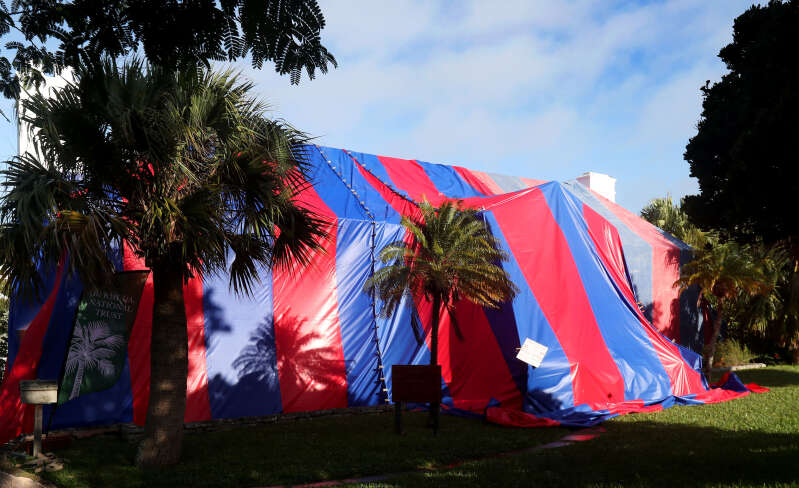
Once termites have left a calling card around your house, it’s time to have your house tented and fumigated.
Those undigested wood pellets, or frass, that you see are a sign that termites are active – and they’re going to continue chowing down on your wooden beams and fine wooden furniture unless the problem is addressed.
Should you see flying termites, or find termite wings, it means termites have likely been in your house for five to seven years because it’s a sign that the colony has grown too big, and termites have started to spread to other pieces of wood.
Justin Tavares is the operations manager at Bermuda Pest Control, which has been in business since 1952, and does around 140 tented fumigations annually.
“Tent fumigations are reserved for treating wood-destroying organisms,” he said.
“The majority are termites, but every now and then, there’s another insect called a powder post beetle that is also a wood-destroying organism.
“If you have them in your house, that’s when you want to get it treated, because it’s a problem that does not go away. It’s just going to keep getting worse and worse and worse. Our advice is always to get it taken care of sooner rather than later.”
Termites live in wood, eating it and expelling the frass.
Mr Tavares said: “Frass is termites’ droppings, and it looks like sand if you put it under a microscope. Termites like to eat wood, but they can’t digest all of it, so they excrete what they can’t eat.
“When you see that, that’s your first sign that an infestation has gotten to a point where it needs to be properly looked at.”
He added: “Termites prefer soft woods, but they’ll eat any wood. A common myth in Bermuda is that they don’t eat cedar. They don’t like cedar, but I can guarantee you they will eat it.”
On the day of a tented fumigation, the Bermuda Pest Control team will arrive with tarps to go over the house, clamps to hold them together, and sandbags to form a tight seal on the ground to ensure that the colourless, odourless gas sulfuryl fluoride – trade name Vikane – is contained inside the house.
Mr Tavares said: “While that’s going on, inside the house everything is being opened to promote good airflow, so drawers, cabinets, dressers, attic spaces, are opened up.
“The only things that need to be out of the home during the fumigation are people, pets and plants.
“We set up fans to help circulate the fumigant. So once all that prep work is done, the technician, who has to be licensed to do so, will release the fumigant into the property.”
He added: “The gas sits and circulates for typically somewhere between 12 and 16 hours. The next day, tents come down, and the house gets aired out. Once that is done, we have special detection devices to make sure that the gas is at a level, which is zero for us, to allow people to reoccupy the space.
“There’s no residual to the gas, so there’s no clean-up. You don’t need to wash dishes. You don’t need to change the linens. You don’t need to wipe down every surface.”
Fumigations, which carry a seven-year warranty, are done year-round.
The only excepted days, for safety reasons, are those where winds exceed 25mph.
Mr Tavares said: “If fumigation is an idea that you’ve been toying with, inspections are free, and quotes are free. Just give us a call and we can come out and help you in any way that we can.”
