
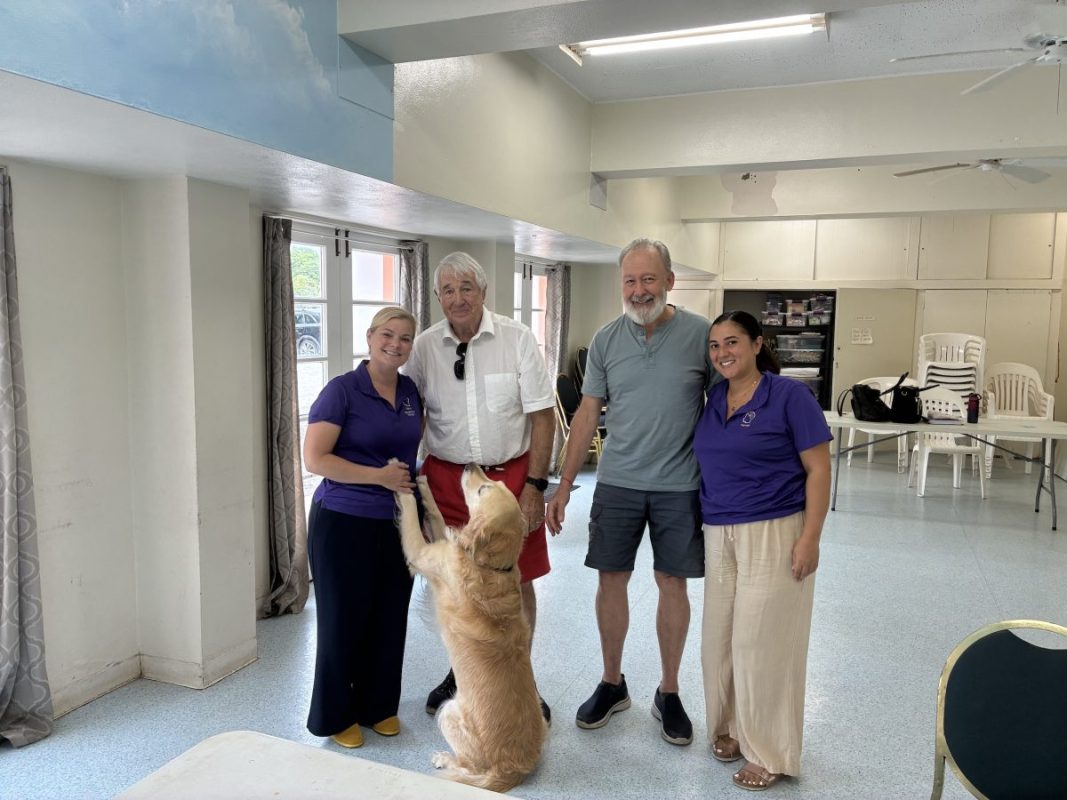
Norman Long’s wife noticed something was wrong before he did.
“She told me I talk a lot of rubbish, and I go from one subject to another,” Mr Long recalled.
“She was the one who dragged me to have my tests.”
Mr Long didn’t need to wait for the results of his cognitive assessment to realise his wife was right.
“I was shocked at how I did in those tests,” he said. “I didn’t realise I was struggling as bad as my wife was telling me. It’s not something you think about.”
Mr Long, 82, a former partner of a shipping company, is showing that an Alzheimer’s diagnosis does not mean the end of living a meaningful and fulfilling life.
Despite moments of frustration and sadness, there is warm gratitude for the people who love and support him – and a healthy habit of finding humour in the face of adversity.
In it together
Humour, in fact, is a key ingredient in Dementia Bermuda’s Cognitive Stimulation Therapy programme, which supports up to 24 people living with dementia.
The twice-weekly sessions at Peace Lutheran Church, Devonshire, include structured cognitive activities and opportunities to socialise with others navigating similar challenges.
When RG Best Health visited the CST programme, we played a memory game called “Guess the Smell”, involving several jars of mystery powders and oils.
The answers – substances like cinnamon, lavender and cumin – didn’t really matter, as the intention was to stimulate conversation and evoke memories associated with the scents.
But the conversation was dominated by light-hearted remarks and laughter, with several members pointing to the irony of a game of senses when “none of us have got any sense”.
They’re currently compiling a joke book from witty one-liners made during sessions, which they intend to publish next year.
CST coordinator Farrah Abdel-Latif explained: “We use humour to handle the reality of the situation. Recently we were playing a game called The Challengers, but they decided to call themselves The Challenged.
“We are all in this together. Norman said to me once, I might not know very much, but I know I want to keep doing this Cognitive Stimulation Therapy. Graham said to me, I might feel crazy out there, but here I feel normal.”
She is referring to Graham Jack, 63, a former manager in the trust industry who is living with dementia.
Mr Jack said when he first developed symptoms, his friends thought he was “punking” them. He went to the doctor as he was struggling with reading and writing.
“They started doing cognitive tests and it just blew me away,” he said. “It was a lot of simple things, like matching animals. I was shocked that I couldn’t do three-quarters of it.”
Cognitive assessment tasks may appear simple, but they are designed to identify changes in different areas of thinking and memory.
CST sessions have helped Mr Jack realise he’s not alone.
He said: “The big thing is being around these people. I was wondering what the heck I could do. I didn’t think I could talk openly in case people had negative vibes.
“Here, people don’t notice if someone like me starts a comment but can’t finish it. It’s just comfortable to be able to respond to a question whether you finish your sentence or not.
“There are probably a lot of people that are sat at home and don’t have the opportunity to be with other people of similar ages doing similar things.”
Mr Long concurred.
“It’s not going to cure me, but it’s certainly helping me understand what’s happening to me when I get frustrated that I can’t remember something,” he said.
“You come here and ask your questions, and they give you the answers.”
Recent assessments showed no measurable deterioration in Mr Long’s cognitive functioning over six months. He continues to attend CST, maintain an active daily routine and benefit from the support of his family.
Bermuda’s growing need
He is worried how people cope when they’re not so fortunate.
“I’m probably better off than a lot of people.
“I’m lucky that I have got a family who support me. I’m very lucky I have a wife who recognised there was something wrong and flagged it.
“I get educated here, but it’s not just about educating people who have dementia. My wife is absolutely wonderful with this.
“Family caregivers have also got to be educated and supported. It’s a big task. It’s not just me – it’s my wife.”
Dementia, of course, affects not only the individual but also those closest to them, making education and support for families equally important.
There are an estimated 3,600 individuals living with dementia in Bermuda, yet Dementia Bermuda’s CST programme currently has capacity for just 24 participants at a time, with a waiting period of about three months.
Marie Fay, clinical director of Dementia Bermuda, said: “CST is an evidence-based, non-pharmacological treatment that can support cognitive functioning and quality of life. It should be recognised as an important part of dementia care in Bermuda, just as it is in countries such as the UK.”
More funding is essential to help Dementia Bermuda expand access to support and meet the island’s growing needs.
Ms Fay said there needs to be a clear pathway of education, care and support throughout every stage of the dementia journey.
“Research suggests that addressing modifiable risk factors could prevent or delay nearly 45 per cent of dementia cases,” she said.
“Brain health is something we should be talking about from childhood, helping young people understand the importance of healthy habits throughout life. This isn’t a challenge that a nonprofit organisation can tackle alone.”
Mr Long said: “It worries the hell out of me that this organisation exists with minimal Government funding.”
The good news, according to Mr Jack, is that the community is willing to support.
In the grocery store, he sometimes asks fellow customers for help reading labels.
“I have done that a lot,” he said.
“Not a single person has given me a funny look or anything else when I say, ‘I have got dementia, would you help me with this?’
“It took a while for me to realise that people don’t really care what you have got – they just want to help.”
- For more information about Cognitive Stimulation Therapy, contact Dementia Bermuda at [email protected] or 707-0600.
