
by Jonathan Starling
What’s past is prologue…
Like many Bermudians born before 1980, my reference for hurricanes was largely shaped by the experience of Hurricane Emily in 1987, when I was eight years old.
While I have experienced many storms since, up until 2003 Emily remained my primary reference.
That changed in 2003. It was my first year of the Regiment, having been conscripted like many Bermudian men before me.
My time in the Regiment coincided with several major storms, and I served in the immediate aftermath of hurricanes in Cayman and Grenada.
But it was Fabian that devastated Bermuda.
I volunteered to serve as part of the Regiment’s rapid response force, along with others from the Corporals Cadre. This meant arriving at Warwick Camp the day before the storm, and spending the long night of the storm in barracks, prepared to deploy even in the midst of the storm, but otherwise with the intention of heading out at first light to begin clearing roads to facilitate both emergency transport and for the rest of the Regiment to muster and deploy.
Many former soldiers will be familiar with the term ‘hurry up and wait’, and that was basically my night during the storm. Some of us played cards. I believe someone had dominoes.
Periodically there would be a crash or a bang outside that would snap us back into the reality of the storm. I almost always have a book with me to kill time, and for Fabian I had brought to camp a paperback version of The Tempest by Shakespeare. It seemed fitting. Throughout the storm and its aftermath – which for me was weeks as a soldier – I read the play over and over.
Destruction
At first light, my team was dispatched towards the hospital, to ensure access was secure. The focus is on ensuring a single lane to the hospital. Clearing two lanes comes later – single lanes ensure emergency access. You have to be careful to look for downed wires first: before you act, you must observe to ensure you yourself do not become the emergency.
Other teams were sent east and west along the main roads – those are the priority after the storm.
Shortly after reaching the hospital and seeing it was clear, my team was dispatched instead to the Deputy Governor’s house. The Governor was off-island, so the Deputy was acting as Commander-in-Chief. Our focus was on clearing his driveway so he could more readily get from A to B. It was there that the radio crackled. We were the closest Regiment team to the Causeway at that time. And we were needed. None of us knew at that moment what the situation was, or why it was urgent to drop what we were doing and head there. Myself, I was just hoping to do something more important than clear a driveway.
On the way we began to speculate what we would find and what we would be doing. Was the Causeway destroyed? Was it blocked? We didn’t know, but we watched the destruction on our way and made mental notes of where we may be needed next.
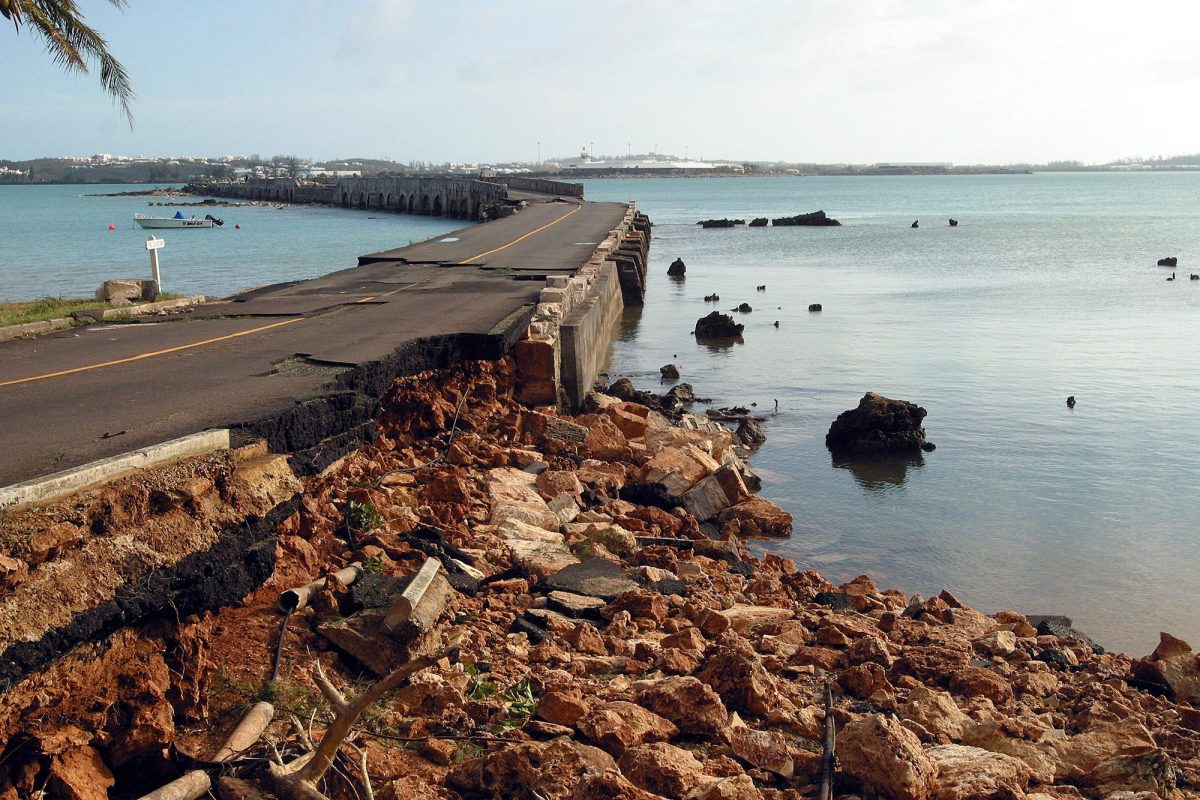
We sped off to the Causeway, only stopping as needed to clear a path to get there. What greeted us shocked us to the core. It is difficult to express the sight: the Causeway was shattered. We knew there was a search and rescue operation underway.
I walked as far as I could to the halfway point of the shattered Causeway, fractured like one sees of earthquakes in the movies. We couldn’t get beyond the midpoint, at least not safely.
Having surveyed the scene, we returned to Grotto Bay, pushed back onlookers as far as Swizzle Inn and set up a security cordon. Only emergency vehicles allowed.
Tragedy
It is said that during war there is a fog, in the sense that one doesn’t fully grasp the whole of what is going on at the time, and only afterwards is one able to sort of piece things together. The same applied after Fabian. We knew that marine police were searching the waters but we didn’t really grasp the severity of the situation, though of course we wondered. Were they looking for something? Someone? Just checking the structural damage? We only learned later, in the barracks, that there had been deaths. It cast a shadow over the barracks as we digested the news with our rations. At that time, our job was to prevent curious onlookers trying to get past us to see the Causeway.
The next few days kept us busy. My unit was mostly clearing roads. I mostly remember the stretch from Watch Hill Park through to Collectors Hill, and then some sites out in the West End, clearing school campuses. We didn’t really have time to reflect on things. It was wake up, eat food, head out, work, back to Warwick Camp, eat, sleep, rinse and repeat. It was only on the anniversary of Fabian, and every hurricane since in the years after that, I’ve had the opportunity to reflect on that day.
There is a certain beauty in the aftermath of storms. The air is fresher. The stars are brighter due to the blackouts. The tree-frogs are louder. There is the hum of generators. I associate the aftermath of hurricanes with the scent of jasmine. I’m not sure why. They can give one a greater appreciation of life, how precious and fragile it is. I spent the next few weeks working hard, clearing debris, sleeping when I could. Appreciating life in the aftermath of the tragedy at the Causeway. My frame of reference for hurricanes was no longer Emily, but Fabian and Shakespeare’s Tempest.
Be not afeard; the isle is full of noises,
Sounds and sweet airs, that delight and hurt not.
Sometimes a thousand twangling instruments
Will hum about mine ears; and sometime voices
That, if I then waked after long sleep,
Will make me sleep again; and then in dreaming,
The clouds methought would open, and show riches
Ready to drop upon me, that when I awaked,
I cried to dream again!
