
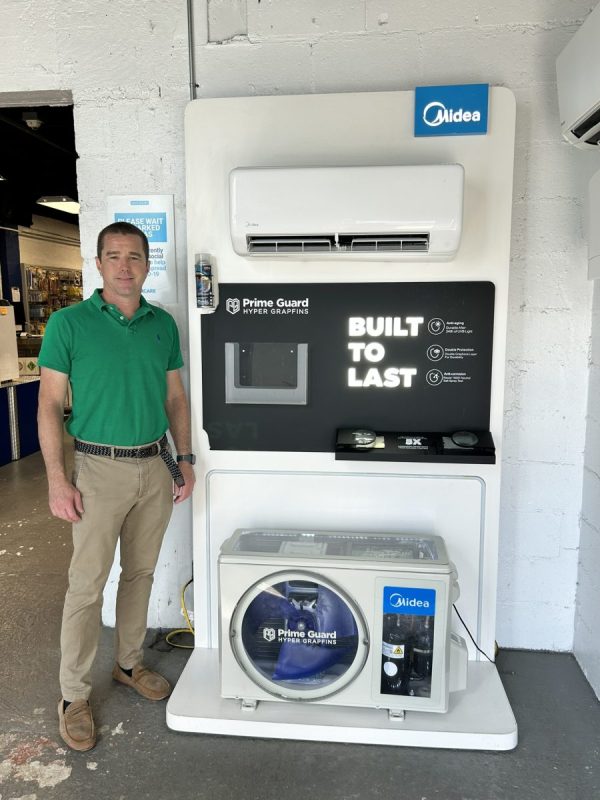
With our long, hot, humid summers, air conditioning is a necessity in Bermuda.
But while we are cooling our bedrooms, we are also contributing to greenhouse gas emissions and sending our electricity consumption soaring.
AirCare Ltd general manager Brendan Stone said there is hope for a greener future, as advances in technology lead to more efficient models.
That’s right, we can reduce our environmental footprint without sacrificing comfort – while also easing monthly utility bills.
“Historically, there have been two major issues with the refrigerants used in air-conditioning units: their global warming potential and their ozone depletion potential,” Mr Stone said.
“Thankfully, the industry no longer uses refrigerants that deplete the ozone layer, but it’s important to understand that the GWP of older air-conditioning models is still quite high.”
Mr Stone said the industry is being driven to improve its technology because governments mandate yearly reductions in the number of harmful emissions associated with refrigerants.
“Whereas older units once had GWP ratings of around 2,000, newer residential and commercial systems can have ratings as low as 466,” he explained.
The hidden cost of holding on
We’re increasingly aware of the harmful effects of older refrigerants, but many of us postpone replacing our air conditioners because of the costs involved.
“Longevity is a double-edged sword,” Mr Stone said.
“Older units will continue to exist until the gas supply needed to operate them is depleted, but they consume more electricity and don’t operate efficiently. In fact, Government energy guidance indicates that HVAC systems typically account for 40 to 50 per cent of household electricity use.”
He explained that all air conditioners work by drawing air across cooling fins to remove heat from a room.
“If an older window unit has rusted out and developed holes in the casing,” he said, “the motor may still be running, but the system can end up pulling hot air in from outside instead of cooling efficiently.
“Failing to install the correct size unit for the space you are trying to cool can also significantly impact energy consumption. Units that are too small for a room will run constantly in an effort to reach the desired temperature, while units that are too large can short-cycle, reducing dehumidification and leaving the room feeling less comfortable.”
Importance of regular maintenance
The best and cheapest way to maintain the air quality inside your home is to keep your system clean and serviced regularly.
Failing to clean the coils and filters causes the system to run longer and less efficiently, while neglecting annual servicing of split-system units can lead to a multitude of headaches.
According to Mr Stone, a filter clogged with dust or mould doesn’t just reduce the efficiency of an air-conditioning system – it can also circulate dust, allergens and mould spores throughout the room you are trying to cool.
And then there are the critters.
Believe it or not, lizards, slugs, tree frogs and flying insects that favour dark, damp spaces can make their way inside the wall unit of a split system, damaging the circuit board and shorting it out.
Energy conservation
The more you use an air conditioner – and the greater the gap between indoor and outdoor temperatures – the harder the system must work and the more energy it will consume.
“A high-efficiency unit used badly can still waste a lot of energy,” Mr Stone said.
“The traditional advice is to set the temperature on your unit to 72F. However, you can potentially save up to 10 per cent simply by raising the temperature by three or four degrees.”
AirCare have some units with smart sensors that automatically raise the temperature in the room by several degrees if you leave for 20 minutes and then lower the temperature again when you return.
Mr Stone added: “Some of the newer systems even have Wi-Fi controls that allow you to use your phone to turn them on and off at specific times during the day, as well as multiple thermostats that can trigger the system to automatically turn the AC on and off in specific areas of the house based on need.”
For maximum energy efficiency, think of your whole house as a cooling system rather than simply focusing on the AC units themselves.
Installing blackout curtains on west-facing windows that receive direct sunlight during the hottest part of the day is one simple, cost-effective way to reduce energy consumption.
As well as blocking out light, these lined window coverings can reduce heat transfer through windows by as much as one-third, depending on the fabric, fit and window type, making a noticeable difference in both room temperature and energy savings.
Solar system considerations
There has been considerable publicity surrounding solar-assisted air-conditioning units that come with their own solar panels. While these systems can help reduce energy consumption, Mr Stone advises consumers to do their research before making a purchase, as many models use solar energy only to power the condenser fan and often operate less efficiently than traditional high-efficiency units.
For truly meaningful energy savings, he believes the better option is to install a rooftop solar panel system configured to help power the home’s air-conditioning units.
However, there is an important caveat.
“You really need professional guidance before installing a new solar system for your house because the number of panels required to power a household is calculated based on your current energy consumption,” he said.
“This means that if you install a new solar system while still using older air-conditioning units, which consume far more energy, you could end up installing more solar panels than you would actually need if you upgraded your air-conditioning systems first.”
